How Much Does an Epoxy Garage Floor Really Cost in 2026?
A full pricing breakdown with real contractor numbers, regional differences, and what separates a $1,500 job from a $6,000 one.
What Epoxy Garage Floors Actually Cost in 2026
$3–$12/sq ft
Installed Price Range
Solid color to metallic
$1,800–$5,400
Typical 2-Car Garage
400–500 sq ft
$2,200
National Average
Flake system, standard prep
The short answer: most homeowners pay between $1,800 and $5,400 to have a 2-car garage professionally coated in 2026. The national average sits around $2,200 for a flake broadcast system with standard prep work. But that range is wide for a reason. A basic solid-color job on clean concrete with minimal repairs is a completely different project than a metallic finish on a 30-year-old slab with cracks and moisture issues.
The most useful way to think about cost is per square foot, because that lets you compare quotes apples to apples. Professional installation runs $3 to $12 per square foot depending on the system you pick, the condition of your concrete, and where you live. That range covers everything from a single-coat solid color on a clean slab to a multi-coat metallic with polyaspartic topcoat on repaired concrete.
Quick Reference: 2026 Costs by Garage Size
| Garage Size | Sq Ft | Solid Color | Flake | Metallic |
|---|---|---|---|---|
| 1-Car | 200–300 | $600–$1,500 | $800–$2,100 | $1,600–$3,600 |
| 2-Car | 400–500 | $1,200–$2,500 | $1,600–$3,500 | $3,200–$6,000 |
| 3-Car | 600–800 | $1,800–$4,000 | $2,400–$5,600 | $4,800–$9,600 |
| 4-Car / Oversized | 900–1,100 | $2,700–$5,500 | $3,600–$7,700 | $7,200–$13,200 |
Good to Know
These numbers assume professional installation with diamond grinding prep. If someone quotes you significantly less, read the "Red Flags" section below before signing anything.
Cost Breakdown by Coating System
Not all epoxy jobs are the same job. The system you choose determines roughly 60% of the final price. Here is what each option actually costs when you break it into materials, labor, and total installed price.
Full Cost Breakdown per Square Foot (2026)
| System | Materials | Labor & Prep | Total Installed | Lifespan |
|---|---|---|---|---|
| Solid Color Epoxy | $0.50–$1.50 | $2.50–$3.50 | $3–$5 | 5–10 years |
| Flake Broadcast | $1.50–$3.00 | $2.50–$4.00 | $4–$7 | 10–15 years |
| Quartz Broadcast | $2.00–$4.00 | $3.00–$6.00 | $6–$10 | 15–20 years |
| Metallic Epoxy | $3.00–$5.00 | $5.00–$7.00 | $8–$12 | 15–20 years |
| Polyaspartic (full) | $2.50–$4.50 | $3.00–$7.50 | $5–$12 | 15–20+ years |
Solid Color Epoxy ($3–$5/sq ft)
The entry point. A single pigmented coat over primed concrete. Fast to install, easy to maintain, and the most affordable option by far. Material cost is minimal at $0.50 to $1.50 per square foot. Solid color works well for utility garages, rental properties, and commercial bays where protection matters more than aesthetics. On a 450 sq ft 2-car garage, expect $1,350 to $2,250 installed.
Flake Broadcast ($4–$7/sq ft)
This is the bread and butter of residential garage work. Vinyl chips are broadcast into wet epoxy, creating a textured, multi-color surface that hides imperfections and adds slip resistance. Material cost runs $1.50 to $3.00 per square foot for professional-grade product. Full broadcast coverage (where you cannot see the base coat at all) costs $1 to $2 more per square foot than partial broadcast, but looks dramatically better. A 2-car garage runs $1,800 to $3,150 for full broadcast with a polyaspartic topcoat.
Quartz Broadcast ($6–$10/sq ft)
Colored quartz granules instead of vinyl chips. The result is a harder surface with better slip resistance and chemical durability than flake. Popular in the Midwest and Northeast where road salt, snowmelt, and freeze-thaw cycles punish lighter-duty systems. Quartz is also the standard choice for garages that double as workshops with heavy tool drops and rolling loads. A 2-car garage runs $2,700 to $4,500 installed.
Metallic Epoxy ($8–$12/sq ft)
The premium option. Metallic pigment powders suspended in clear resin create flowing, marbled patterns that are unique to every floor. The material cost difference between metallic and flake is only $1.50 to $2.00 more per square foot, but installers charge $4 to $5 more because the application requires real skill. Manipulating pigments with solvent, heat, and technique during a tight working window is not something you learn from a YouTube video. A 2-car garage runs $3,600 to $5,400.
Polyaspartic / Hybrid Systems ($5–$12/sq ft)
Polyaspartic coatings cure in 2 to 4 hours (versus overnight for epoxy), are completely UV stable, and resist hot tire pickup better than any pure epoxy system. The catch: polyaspartic material costs more, and the fast cure time means your crew has to move quickly with no room for hesitation. Many contractors now run a hybrid approach, using an epoxy primer and base for adhesion and a polyaspartic topcoat for performance. That hybrid system runs $6 to $10 per square foot installed and is quickly becoming the professional standard for garage work.
Margin Insight
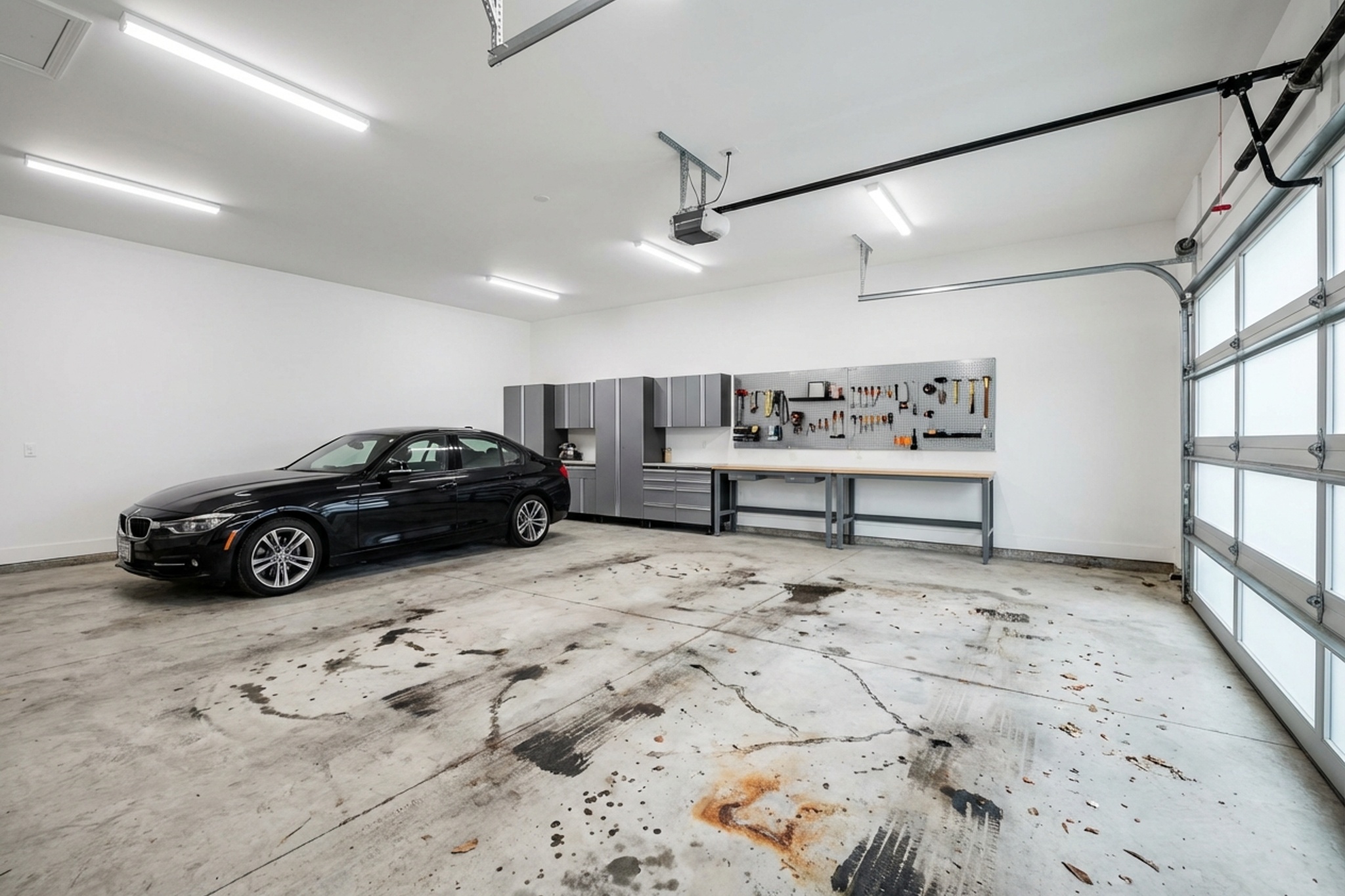
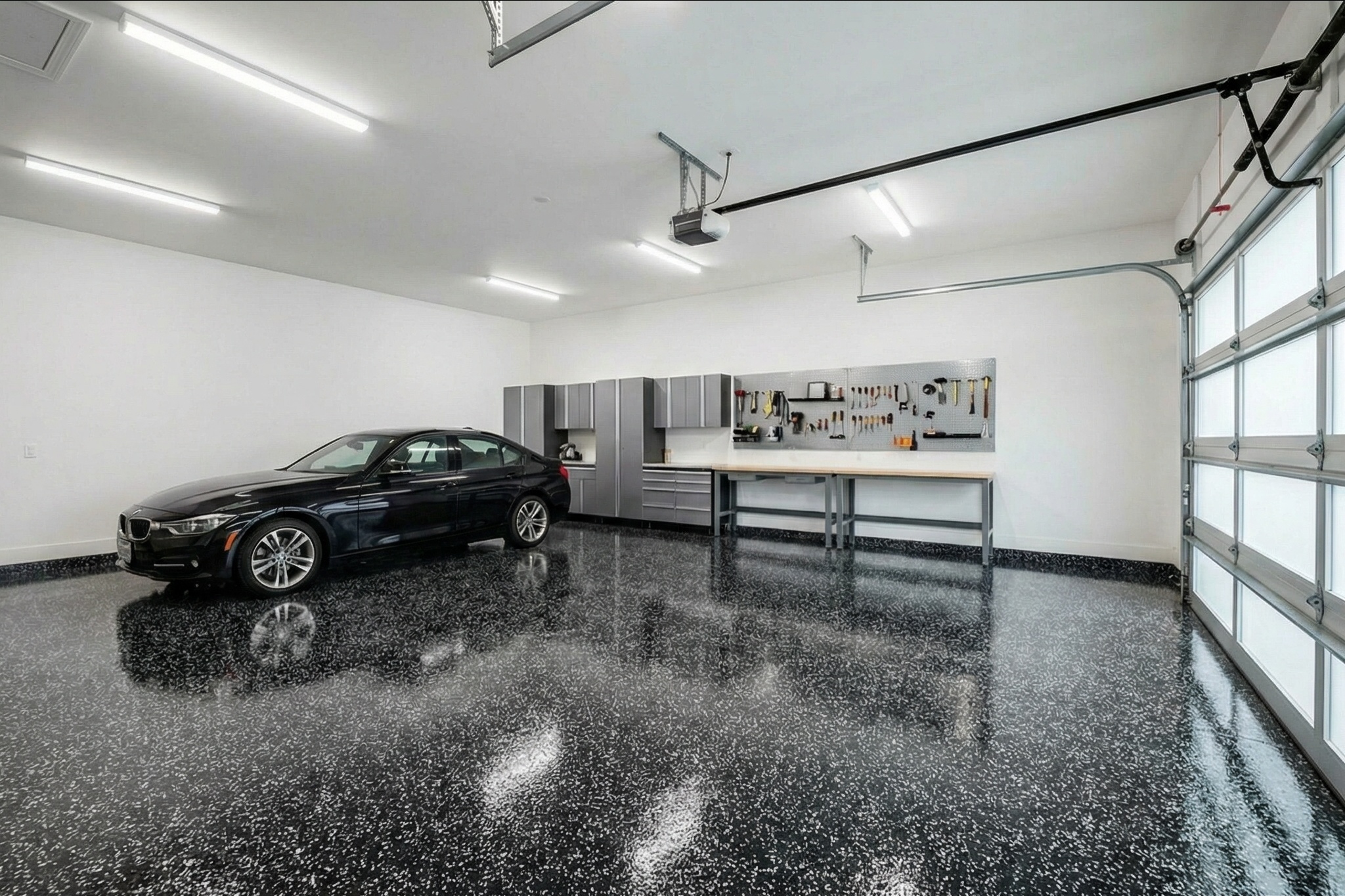
For contractors: preview solid, flake, and metallic finishes in the same garage to discuss their differences. Price each system from its product, preparation, and installation requirements.
What Drives the Price Up
The gap between a $1,500 garage job and a $6,000 one is not just the coating system. These are the factors that push costs toward the high end, and most of them relate to what is happening under the coating, not on top of it.
Concrete Condition and Repairs
This is the biggest variable. A clean, crack-free, never-sealed slab is a dream job. A 25-year-old slab with oil stains, spalling, previous coatings, and hairline cracks everywhere is a different animal. Crack filling runs $2 to $5 per linear foot for minor cracks and $5 to $15 per foot for structural repairs. Spalling or delaminated patches cost $3 to $8 per square foot to repair. Oil stain removal adds $50 to $200 depending on severity. If an old coating needs to be stripped first, add $3 to $8 per square foot for removal.
Moisture Problems
Garages built on slabs without vapor barriers can transmit enough moisture through the concrete to cause coating failure. A basic moisture test (plastic sheet method or calcium chloride kit) costs $200 to $500. If the test shows high moisture vapor emission rates, a moisture-mitigating primer is required, adding $1.00 to $2.00 per square foot to the job. Skip this step and the coating bubbles and peels within a year.
Garage Size and Layout Complexity
Bigger garages cost more in absolute dollars but less per square foot because setup, equipment transport, and mobilization costs get spread across more area. A 1-car garage at 250 sq ft might run $8 per square foot while the same system on a 1,000 sq ft 4-car garage drops to $6 per square foot. Odd layouts, multiple columns, and lots of edges slow the crew down and push costs back up.
Number of Coats and Topcoat Choice
A single-coat system with no topcoat is the cheapest option and the least durable. The professional standard is a 3-layer system: primer, pigmented base coat, and clear topcoat. A polyaspartic topcoat adds $1.50 to $3.00 per square foot but delivers UV stability, hot tire resistance, and a 15 to 20 year lifespan. A polyurethane topcoat costs less ($1.00 to $2.00/sq ft) but takes longer to cure and is slightly less durable.
- Concrete repairs (cracks, spalling, old coatings): +$1–$8/sq ft
- Moisture mitigation primer: +$1–$2/sq ft
- Coating removal (existing paint or epoxy): +$3–$8/sq ft
- Polyaspartic topcoat upgrade: +$1.50–$3/sq ft
- Complex layout (columns, jogs, steps): +10–20% labor
- Custom color matching or multi-color metallic: +$1–$3/sq ft
What Drives the Price Down
Good news: plenty of factors work in your favor. If your garage checks a few of these boxes, your project will land on the lower end of the range.
- Clean, crack-free concrete with no previous coatings. A slab in good condition can save $500 to $1,500 on prep alone.
- Standard colors from the contractor's existing inventory. Custom color matching adds cost. Picking from stock blends does not.
- Simple rectangular layout with no columns, steps, or jogs. Straight walls and open floor plans mean faster work.
- Scheduling in the off-season. January through March (and mid-summer in hot climates) is slow season for most coating contractors. You may get 10 to 15% off.
- Bundling multiple areas. Getting the garage and a basement or patio done at the same time reduces mobilization costs per square foot.
- Being a repeat customer or referral. Many contractors offer 5 to 10% discounts for return clients.
- Choosing a standard 2-coat system (base + topcoat) instead of a 3-coat premium system. Saves $1 to $2/sq ft.
Pro Tip
The single biggest way to keep costs down is to have your concrete in decent shape before the crew arrives. Move everything out of the garage, sweep thoroughly, and clean up any oil spots with degreaser. Prep time is labor time, and labor time is your money.
Regional Pricing Differences
Where you live matters. Labor rates, cost of living, contractor density, and even climate all affect what you pay. A flake broadcast job that costs $5 per square foot in Dallas might cost $8 per square foot in Manhattan. Here is how the numbers break down by market type.
Regional Price Variation (Flake Broadcast, Professional Install)
| Market | Price/sq ft | Typical 2-Car Garage | Notes |
|---|---|---|---|
| National Average | $4–$7 | $1,800–$3,150 | Baseline for most suburban areas |
| High-Cost (NYC, SF, LA, Boston) | $6–$10 | $2,700–$4,500 | 15–25% premium, higher labor rates |
| Mid-Cost (Chicago, Denver, Atlanta) | $5–$8 | $2,250–$3,600 | Close to national average |
| Low-Cost (Houston, Phoenix, Raleigh) | $3.50–$6 | $1,575–$2,700 | More contractors, competitive pricing |
| Rural / Small Town | $4–$7 | $1,800–$3,150 | Lower labor, but fewer experienced pros |
Warm-weather states like Florida, Arizona, and Texas tend to have more coating contractors per capita because garage and patio coatings are year-round work there. More competition means more aggressive pricing. In contrast, contractors in the Northeast and Midwest have a shorter installation season and higher overhead, which gets passed along to the customer.
One thing to watch: in high-cost markets, the gap between "budget" and "quality" quotes is often wider. You might get a quote for $3.50/sq ft and another for $9/sq ft for what sounds like the same job. The difference is almost always in prep quality, material grade, and warranty coverage. In competitive markets like Phoenix or Houston, even the quality contractors price aggressively because they have to.
Good to Know
Always compare quotes within your own metro area. National averages are useful for ballpark estimates, but your actual cost depends on local labor markets. Get at least three quotes from contractors who will visit your garage in person before pricing.
DIY vs. Professional: The Real Cost Comparison
The big-box store epoxy kit for $100 to $300 looks like an obvious win over a $3,000 professional job. But the sticker price is not the real cost. Here is what the numbers look like when you account for everything.
True Cost Comparison: DIY vs. Professional (2-Car Garage)
| Factor | DIY Kit | Professional Install |
|---|---|---|
| Material cost | $100–$500 | $675–$2,250 |
| Equipment rental (grinder, etc.) | $150–$400 | Included |
| Your labor (8–16 hours) | $0 (your time) | Included |
| Surface prep quality | Acid etch (inconsistent) | Diamond grinding (CSP 2–3) |
| Moisture testing | Usually skipped | Included ($200–$500 value) |
| Coating thickness | 3–5 mils | 12–20+ mils |
| Expected lifespan | 1–3 years | 10–20 years |
| Failure rate | 30–40% within year 1 | <5% with proper prep |
| Redo cost if it fails | $2,000–$4,000+ | Covered by warranty |
| Total real cost (10-year view) | $1,500–$4,500+ | $1,800–$5,400 |
That 10-year view is the important one. DIY kits use water-based formulas with 30% solids content. Professional systems use 100% solids or high-solids formulas that go down 3 to 4 times thicker. The DIY kit peels in year two, you spend $2,000 to $4,000 stripping the failed coating and having it done professionally (stripping costs more than coating virgin concrete because the old material has to come off first), and now your total spend exceeds what the professional job would have cost on day one.
DIY Epoxy Kits
Pros
- Low upfront cost ($100–$500)
- Weekend project if concrete is in good shape
- Acceptable for rental properties or garages you plan to sell
Cons
- 30–40% failure rate within the first year
- Acid etching creates inconsistent adhesion profile
- Thin coats (3–5 mils) wear through in high-traffic areas
- No UV stability, will yellow near garage door
- If it fails, stripping and redo costs $2,000–$4,000, more than the original pro job
- No moisture testing means you are gambling on the slab condition
"I fix DIY epoxy floors every month. The cost to strip and redo it professionally is double what it would have cost to do it right the first time."
Warning
Water-based epoxy is the most common formula in retail kits. It is cheap for a reason. Multiple professional installers say the same thing: "Stay away from water-based epoxy. It will fail within a short period." If you go DIY, at minimum use a 100%-solids or high-solids product designed for garage floors, not a $75 kit from the hardware store.
Red Flags in Cheap Quotes
If you are shopping for epoxy garage floor quotes, you will see a huge spread. One contractor quotes $4,500 for your 2-car garage. Another quotes $1,800. A third says $1,200. The cheapest quote is not the best deal. It is usually the most expensive mistake you can make.
What "$3 Per Square Foot" Actually Means
At $3 per square foot, there is no mathematical way to include diamond grinding, quality materials, and a polyaspartic topcoat while paying a skilled crew and still making a profit. Something has to give. Usually it is the prep. Sometimes it is the material grade. Often it is both.
A well-known example from contractor forums: a homeowner paid $3,700 for an 1,100 sq ft garage floor. That works out to $3.37 per square foot. Within 10 months the coating was chipping and peeling. Every professional who weighed in said the same thing: at that price point, there was no budget for proper prep or quality product. The minimum for a quality install on a standard slab is $5 to $7 per square foot for flake and $9 to $13 per square foot for metallic. Below that, corners are being cut.
- 1They skip diamond grinding and use acid etching instead. Acid etch does not remove old sealers or create a consistent profile. It is a shortcut that leads to adhesion failure.
- 2They use water-based or low-solids epoxy instead of 100% solids. The coating goes down thin, wears fast, and yellows.
- 3They skip the moisture test entirely. If the slab has moisture issues, the coating fails within months.
- 4They do not include a topcoat, or they use an epoxy clear coat instead of polyaspartic. No UV stability, no hot tire resistance.
- 5They do not include crack repair in the quote, then hit you with change orders on install day.
- 6No warranty, or a warranty with so many exclusions it covers nothing.
- 7They quote over the phone without seeing the garage. No one can accurately price concrete work without looking at the slab.
The Lowball Quote Math
On a 500 sq ft garage at $3/sq ft ($1,500 total), here is where the money actually goes: materials at $1.50/sq ft ($750), labor at $1/sq ft ($500), and the remaining $250 for overhead and profit. There is zero budget for diamond grinding ($1–$2/sq ft), crack repair, moisture testing, or a quality topcoat. Either the installer is losing money, or more likely, they are skipping every step that makes the coating last.
How to Get the Best Value
Getting a good deal on an epoxy garage floor is not about finding the cheapest quote. It is about understanding what a fair price looks like for quality work, and knowing what to ask before you sign.
Questions to Ask Every Contractor
What is your surface prep method?
The answer should be "diamond grinding" or "shot blasting." If they say "acid etching" or "just a good cleaning," find someone else. Proper surface prep accounts for 75% of the coating's long-term performance.
What product system are you using?
Ask for the specific brand and product line. Professional-grade systems (Penntek, Polyurea Garage Floors, Torginol, ArmorClad) use 100% solids or high-solids formulas. If they cannot name the product, that is a red flag.
How many coats and what is the topcoat?
A quality job includes at minimum a primer, pigmented base coat, and clear topcoat. The topcoat should be polyaspartic or polyurethane for garages. An "epoxy clear" topcoat will yellow from UV.
Do you moisture test the slab?
Any contractor who says "we don't need to on garages" is gambling with your money. Garages are less prone than basements, but slabs without vapor barriers can still cause delamination.
What does your warranty cover?
A solid warranty covers peeling, delamination, and hot tire pickup for at least 5 years. Read the exclusions. Some warranties only cover materials (not labor to redo the job), which makes them nearly worthless.
Can I see photos of jobs from 2 or 3 years ago?
New epoxy always looks great. The real test is how it holds up after a few winters, hot tires, and road salt. Any good contractor should have photos or references from older jobs.
What a Good Quote Includes
- An in-person visit to assess the slab condition before pricing
- Itemized pricing: prep, materials, labor, topcoat listed separately
- Specific product names and manufacturers
- Surface prep method clearly stated (diamond grinding or shot blasting)
- Crack repair and patching included or priced as a line item
- Moisture testing included
- Topcoat type specified (polyaspartic or polyurethane)
- Clear warranty terms with both material and labor coverage
- Expected timeline: how many days and when you can drive on it
The Smart Way to Compare Quotes
Get three quotes minimum and compare them line by line. The cheapest total is often cheap because it is missing items the other quotes include. If one quote is $1,500 and two are $3,200 to $3,500, the outlier is not a deal. It is a different (worse) job. Also ask each contractor what they would charge to fix a failed DIY or cheap professional job. That number ($2,000 to $4,000+) tells you the true cost of going cheap.
Material Costs: What Contractors Actually Pay
Understanding what materials cost helps you evaluate whether a quote is reasonable. Here is what the components run at contractor pricing in 2026.
Material Cost Breakdown (Contractor Pricing)
| Component | Cost/sq ft | Notes |
|---|---|---|
| Penetrating epoxy primer | $0.50–$1.00 | Essential for adhesion. Never skip. |
| Solid color epoxy base | $0.50–$1.50 | 100% solids preferred over water-based |
| Flake chips (vinyl) | $0.30–$0.75 | Full broadcast uses 2–3x more material than partial |
| Metallic pigment powder | $0.75–$2.00 | $15–$30/lb. Coverage varies by color intensity. |
| Quartz aggregate | $0.50–$1.50 | Colored quartz granules for broadcast |
| Polyaspartic topcoat | $1.50–$3.00 | UV stable, fast cure, hot tire resistant |
| Polyurethane topcoat | $1.00–$2.00 | Budget alternative. Slower cure. |
| Moisture-mitigating primer | $1.00–$2.00 | Only needed if moisture test fails |
| Crack filler (polyurea) | $2–$5/linear ft | Flexible. Do not use rigid epoxy for cracks. |
For a typical 450 sq ft 2-car garage flake job, total material cost runs $675 to $1,350 at contractor pricing. That includes primer, base coat, full-broadcast flake, and a polyaspartic topcoat. The rest of the invoice is labor, equipment, overhead, and profit. Most successful epoxy contractors maintain 40 to 50% gross margins, which is healthy and appropriate for skilled trade work that requires $15,000 or more in equipment.
Good to Know
If a contractor's quote puts materials at less than 25% of the total, that is normal for residential work. Labor and prep are the majority of the cost. If materials are more than 50% of the total, either the labor portion is underpriced (meaning less prep time) or they are using premium product on a smaller job.
Featured Materials
$3–$5/sq ft
Solid Gray
Entry-level protection. Clean, uniform look for budget-conscious clients.
$4–$7/sq ft
Domino Flake
Mid-range best seller. Full-broadcast flake hides imperfections and adds grip.
$6–$10/sq ft
Saddle Tan Quartz
Premium texture and chemical resistance. Ideal for heavy-use garages.
$8–$12/sq ft
Silver Metallic
Highest margin system. Unique flowing patterns that justify premium pricing.
See What Your Garage Could Look Like
Upload a photo of your garage and preview it in flake, metallic, or quartz, then build a proposal from the selected direction. Free to try, no account required.