Garage Floor Coating Options Explained
Epoxy, polyaspartic, polyurea, paint, polished concrete, and tiles. A contractor's honest comparison with real costs, real durability numbers, and a framework for matching the right system to the right client.
Every Garage Coating Option at a Glance
6 systems
Coating Categories
Epoxy, polyaspartic, polyurea, paint, polished, tiles
$0.50–15/sq ft
Full Price Range
Budget paint to premium polyurea
1–20+ yrs
Lifespan Spread
Depends on system and prep quality
Six categories of garage floor coating compete for your client's budget. Each one fills a different slot in terms of price, performance, and timeline. Some contractors only offer one system. The ones who make the most money offer three or four and match the right system to each client's priorities.
This guide breaks down every option with real installed pricing, honest durability numbers, and the tradeoffs you need to communicate during an estimate. No fluff. If a system has problems, we say so.
Master Comparison: All Garage Floor Coating Systems
| System | Cost/sq ft (Installed) | Lifespan | Cure Time | UV Stable | DIY Viable | Best For |
|---|---|---|---|---|---|---|
| 100% Solids Epoxy | $4–12 | 10–20 yrs | 3–5 days | No (needs topcoat) | No | Most residential garages |
| Water-Based Epoxy | $2–4 | 2–5 yrs | 3–5 days | No | Yes | Budget residential |
| Polyaspartic | $6–14 | 15–20+ yrs | 4–6 hours | Yes | No | Fast turnaround, premium |
| Polyurea | $7–15 | 15–20+ yrs | 1–4 hours | No (most formulas) | No | Commercial, chemical exposure |
| Garage Floor Paint | $1–3 | 1–3 yrs | 24–48 hours | Varies | Yes | Rental properties, temporary |
| Polished Concrete | $3–8 | 20+ yrs | None (mechanical) | No | No | Good slabs, minimal look |
| Interlocking Tiles | $3.50–8 | 10–15 yrs | None | N/A | Yes | Zero-prep, renters, show cars |
Margin Insight
Present three options at every estimate: a value system, a mid-range system, and a premium system. Show each one as a visualization on the client's actual garage. Use the previews to discuss the differences, then build the proposal around the finish and scope the customer chooses.
Epoxy Coatings: The Industry Standard
Epoxy is a two-part system (resin plus hardener) that cures through a chemical reaction to form a hard, bonded coating on concrete. It has been the go-to garage floor coating for decades, and for good reason. It handles oil drips, brake fluid, road salt, dropped tools, and hot tires (with the right topcoat). It comes in more colors and decorative options than any other system. And clients recognize the name.
But not all epoxy is created equal. The term covers three very different product categories, and the differences between them are the difference between a floor that lasts two years and one that lasts twenty.
100% Solids Epoxy
100% solids epoxy contains no water or solvent carriers. When it cures, nothing evaporates. You get the full thickness of what you apply, typically 10-12 mils per coat. That thick film is what gives professional epoxy its chemical resistance, impact strength, and longevity. Products like Sherwin-Williams ArmorSeal, Dur-A-Flex Poly-Crete, and Torginol systems fall into this category.
Material cost runs $1.50-5.00/sq ft depending on the system. Pot life is short, around 30-40 minutes, which means you need to work fast and in manageable batches. A two-person crew can coat a standard 2-car garage (450 sq ft) in one day, but the floor needs 3-5 days before vehicle traffic. This is the product professional contractors use on 90% of residential garage jobs.
Water-Based Epoxy
Water-based epoxy is what you find in the retail kits at Home Depot and Lowe's. Rust-Oleum EpoxyShield, KILZ 1-Part Epoxy, and similar products. The water evaporates during cure, leaving behind a thinner film of 3-4 mils. That thinner film means less protection, less chemical resistance, and a shorter lifespan. Expect 2-5 years under normal garage conditions.
The advantage is ease of application. Longer pot life (about two hours), lower odor, easy soap-and-water cleanup. Homeowners can apply it with basic tools. It is fine for a light-duty garage where the owner parks one car and does not work on vehicles. It is not fine for a working garage, and it is not something you should install for a paying client.
Solvent-Based Epoxy
Solvent-based epoxy sits between the two. Higher solids content than water-based (typically 50-70%), better adhesion on slightly damp or contaminated concrete, and moderate chemical resistance. It builds 6-8 mils per coat. The tradeoff is VOCs: solvent-based epoxy puts off serious fumes and requires proper ventilation and respiratory protection during application. Its use is declining as 100% solids products improve.
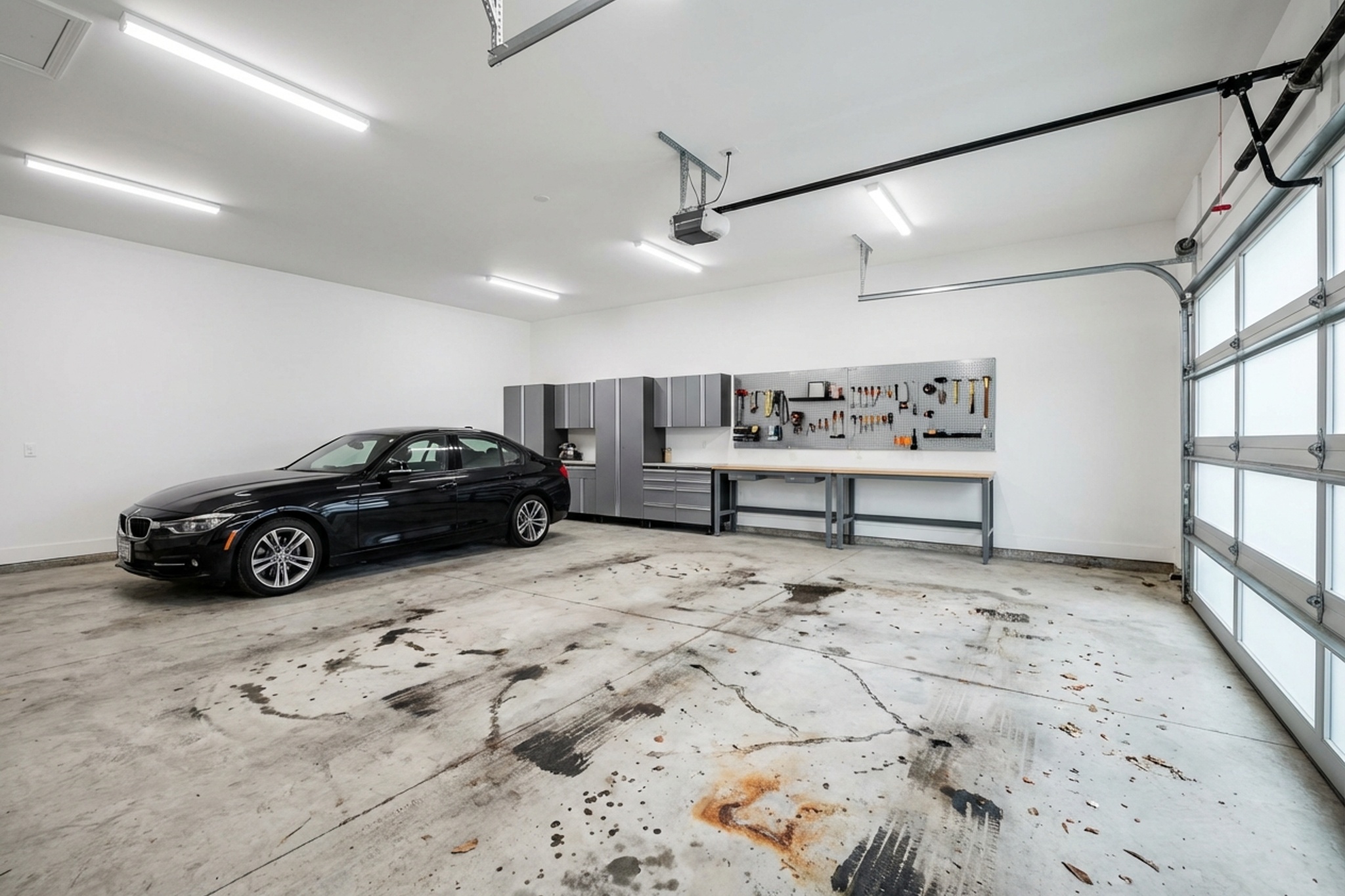
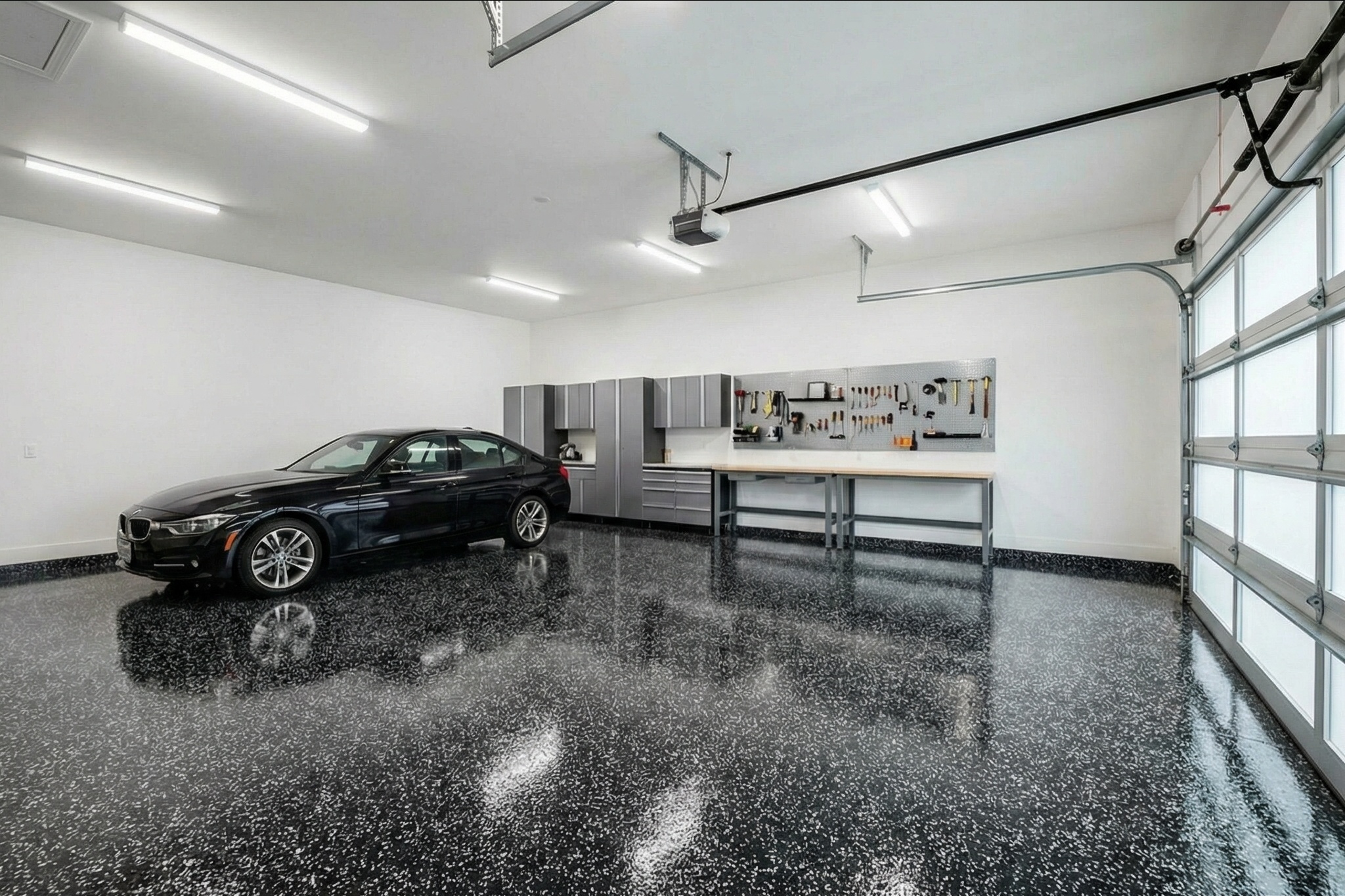
Epoxy Coatings (100% Solids)
Pros
- Proven track record spanning 40+ years in residential and commercial
- Widest range of decorative options: flake, metallic, quartz, solid color
- Excellent chemical resistance against oil, fuel, brake fluid, and road salt
- Builds thick protective film (10-12 mils per coat)
- Lowest material cost per mil of thickness among professional systems
- Familiar to most contractors, well-documented application procedures
Cons
- 3-5 day cure time before vehicle traffic
- Yellows under UV exposure without a UV-stable topcoat
- Rigid film can crack if concrete shifts or settles
- Hot tire pickup possible without polyaspartic or polyurethane topcoat
- Short pot life (30-40 min) requires fast, practiced application
Polyaspartic Coatings: Fast Cure, UV Stable
Polyaspartic coatings are the fastest-growing product category in garage flooring. They are a modified form of polyurea, engineered for easier application and longer working time than pure polyurea while keeping the fast cure and UV stability. Apply in the morning, light foot traffic by afternoon, vehicle traffic by the next morning. That timeline is the single biggest selling point.
The chemistry is straightforward. Polyaspartic is an aliphatic polyurea ester. The "aliphatic" part means it does not break down under UV light, so the coating stays clear and does not yellow even in a south-facing garage with the door open all day. It also resists hot tire pickup without needing a separate topcoat because it is thermoset, not thermoplastic.
Installed cost runs $6-14/sq ft depending on the system build. A standard 2-car garage at 450 sq ft: $2,700-$6,300. Material cost is $3-6/sq ft, which is higher than epoxy. But the speed of installation changes the economics. A polyaspartic job that takes one day generates revenue per labor hour that matches or beats a two-day epoxy job.
Standalone vs. Hybrid Systems
You can run polyaspartic as a complete system: polyaspartic primer, polyaspartic base coat, polyaspartic topcoat. All applied in one day. The downside is a thinner overall build than epoxy. Each coat goes on at 5-8 mils wet, but polyaspartic shrinks more during cure. Total dry film thickness is typically 12-18 mils vs. 20-30+ mils for a full epoxy system.
The hybrid approach has become the industry standard for quality-focused contractors: epoxy primer and base coat on day one (maximizing thickness and decorative potential), polyaspartic topcoat on day two (adding UV stability, hot tire resistance, and fast final cure). The client drives on it day three. This hybrid runs $5-10/sq ft installed and gives you the best of both chemistries.
Pro Tip
When a client says "I need my garage back fast," that is your cue to quote polyaspartic. The speed justifies a $2-4/sq ft premium over straight epoxy, and most homeowners will pay it without pushback once they realize the alternative is parking in the driveway for a week.
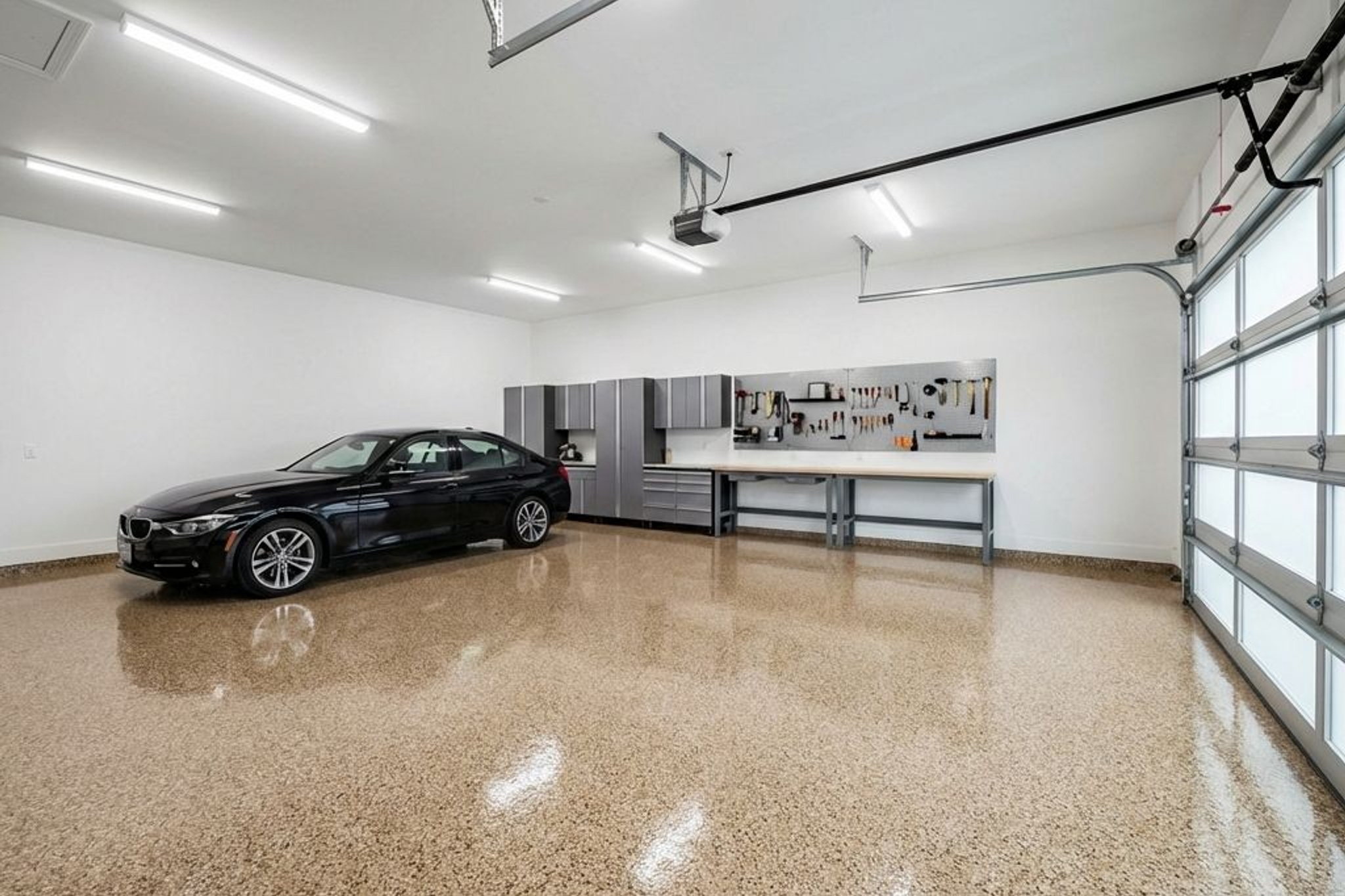
Polyaspartic Coatings
Pros
- Same-day return to foot traffic, next-day vehicle traffic
- UV stable: will not yellow or amber, even with direct sun exposure
- Inherent hot tire resistance (thermoset chemistry)
- Can apply in a wider temperature range than epoxy (down to 30°F)
- Excellent abrasion and chemical resistance
- High contractor margin due to speed of installation
Cons
- Higher material cost ($3-6/sq ft vs. $1.50-5/sq ft for 100% solids epoxy)
- Working time is 30-90 minutes, so mistakes must be fixed fast
- Thinner per-coat build than 100% solids epoxy
- Fewer decorative options than epoxy (metallic patterns are limited)
- Requires experienced crews comfortable with fast-cure products
Polyurea Coatings: Flexibility and Chemical Resistance
Pure polyurea is the heavy-duty option. It cures in minutes (not hours), forms an extremely flexible film that stretches up to 400% without cracking, and resists a wider range of chemicals than epoxy or polyaspartic. It is roughly four times stronger than epoxy in impact and tensile strength testing.
The fast gel time (measured in seconds for spray-applied systems) means pure polyurea requires plural-component spray equipment costing $15,000-30,000. You cannot roll it on with a paint roller. This limits who can install it and drives the installed cost to $7-15/sq ft. For a 450 sq ft garage, that is $3,150-$6,750.
Where Polyurea Makes Sense
Polyurea earns its premium in environments where other systems fall short. Garages that double as workshops with chemical exposure. Cold-climate installations where the coating needs to flex through freeze-thaw cycles without cracking. Floors subject to thermal shock from welding sparks or hot equipment. Commercial bays with constant heavy vehicle traffic.
One thing to know: most aromatic polyurea formulations are NOT UV stable. They will yellow over time with sun exposure, just like epoxy. Only aliphatic polyurea (which includes polyaspartic) resists UV. If a client is comparing "polyurea" to polyaspartic on UV stability, make sure they are comparing the right chemistries.
Warning
Some franchise coating companies market their product as "polyurea" when they are actually using polyaspartic (a subset of polyurea). There is nothing wrong with polyaspartic, but the franchise markup can add $3-5/sq ft over what an independent contractor charges for the same chemistry. Know what you are bidding against.
- Pure polyurea: $7-15/sq ft installed. Requires spray equipment. Best for commercial and industrial.
- Polyurea/polyaspartic hybrid: $6-12/sq ft installed. Roller-applied. The practical choice for residential.
- Franchise polyurea systems (Garage Kings, GarageExperts, etc.): $8-18/sq ft. Same chemistry, higher markup.
Garage Floor Paint: Why It Fails and When It's OK
Latex garage floor paint costs $0.50-1.50/sq ft for materials and $1-3/sq ft installed. A 450 sq ft garage painted by a handyman runs $450-$1,350. It is the cheapest option on this list by a wide margin. It also fails the fastest.
Paint sits on top of concrete. It does not chemically bond to the surface the way epoxy and polyurea do. It cannot penetrate the pores. Under friction from tires, pressure from parked vehicles, and temperature swings through the seasons, paint cracks, chips, and peels. Hot tire pickup is almost guaranteed. Expect visible wear within 6-12 months and repainting every 1-3 years.
Latex Paint vs. Epoxy Paint
Big-box stores sell "epoxy paint" that creates confusion. Products like BEHR Premium 1-Part Epoxy and KILZ 1-Part Epoxy are acrylic-latex paints with a small amount of epoxy resin blended in. They are not epoxy coatings. The epoxy content improves adhesion slightly over straight latex, but the film is still 2-3 mils thick and does not approach the performance of a real two-part epoxy system.
True two-part epoxy (sold as kits by Rust-Oleum and others) performs better than latex but still uses a water-based formula that leaves a thin film. They cost $200-500 for a 2-car garage kit. Results are inconsistent because the acid etch included in the kit does not create the surface profile that diamond grinding provides.
When Paint Is the Right Call
- Rental properties where the landlord needs a clean look on a tight budget and plans to repaint every lease cycle.
- Commercial tenants who do not own the building and cannot modify the slab permanently.
- Homeowners selling within 6 months who want the garage to photograph well for listing photos.
- Temporary solution while saving for a proper coating system.
Good to Know
Do not argue with a client who wants paint. Be transparent about the lifespan, document it in writing, and offer to do the proper coating when they are ready. Many professional installers report that their best coating leads come from homeowners who tried paint first and watched it peel within a year.
Polished Concrete: When the Slab Is Good Enough
Polished concrete is not a coating. It is a mechanical process that grinds the existing slab with progressively finer diamond tooling until the surface reaches a desired sheen level. No product is applied (aside from an optional densifier that hardens the surface). The result is a smooth, reflective floor that looks like natural stone.
Cost runs $3-8/sq ft depending on the level of polish and condition of the existing slab. A 450 sq ft garage: $1,350-$3,600. It takes 1-2 days and the floor is ready for traffic immediately. No cure time. No smell. No VOCs.
When Polished Concrete Works in a Garage
Polished concrete works when the slab is in good condition: no major cracks, no spalling, no oil stains that penetrate deep into the concrete. It works when the client wants a minimalist, industrial look rather than a decorative coating. And it works when the client values low maintenance. Polished concrete just needs sweeping and occasional damp mopping. No resealing, no topcoat refreshes.
It does not work when the slab is damaged, stained, or has moisture problems. It does not hide imperfections the way epoxy or polyaspartic does. Scratches from gravel and tools are more visible on a polished surface. And polished concrete can be slippery when wet, which is a concern in garages where snow-covered vehicles drip onto the floor.
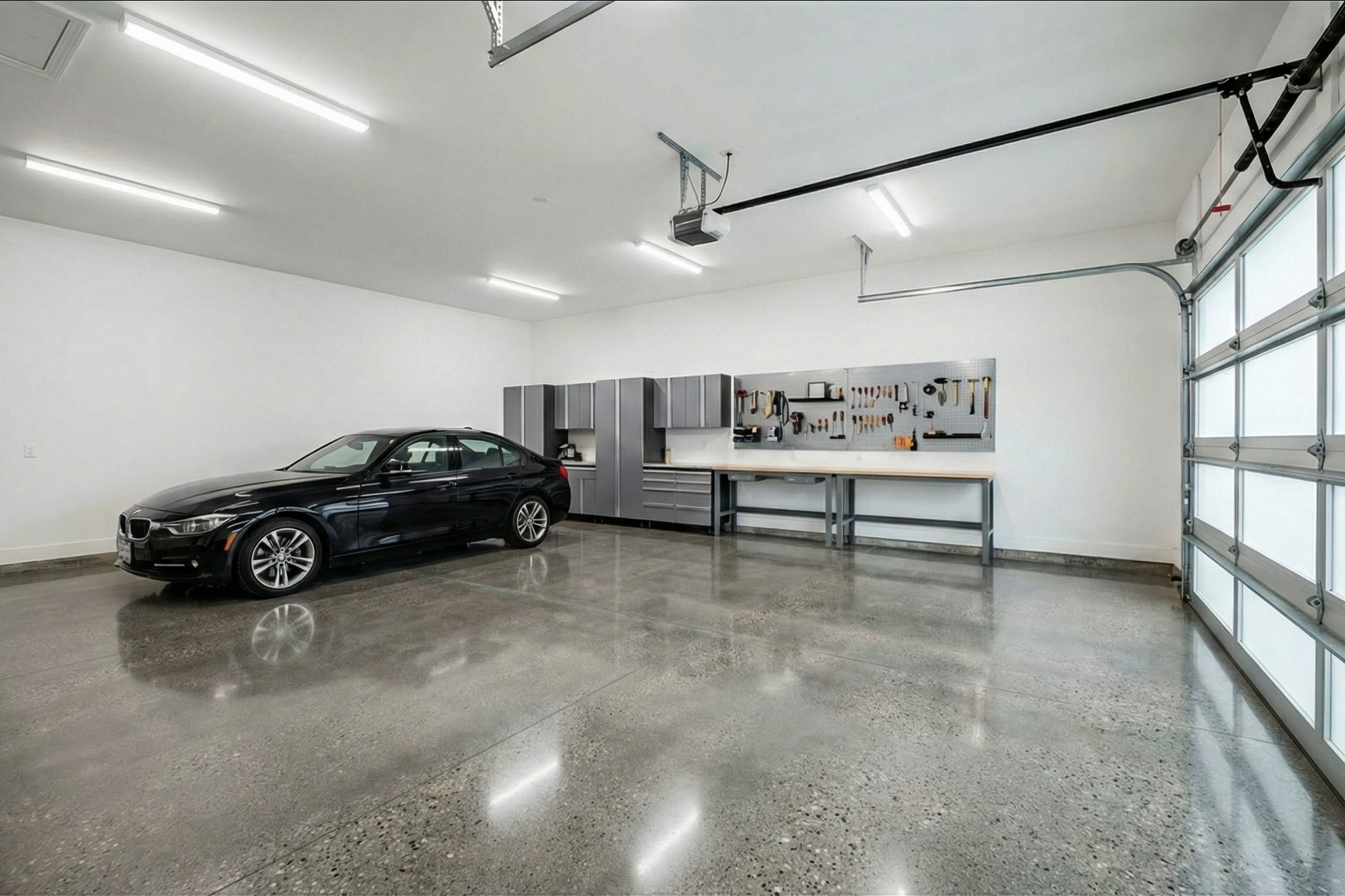
- Slab is in good condition with no major cracks or spalling
- No deep oil stains that would show through the polish
- Client prefers a natural concrete look over decorative finishes
- Low maintenance is a top priority
- No moisture issues (polished concrete does not block vapor transmission)
- Slip resistance in wet conditions is addressed (non-slip additive or mats at entry)
Interlocking Tiles and Mats
Interlocking tiles are the only garage floor option that requires zero surface prep, zero adhesive, and zero cure time. Snap them together directly over the existing slab. Drive on them the same day. Pull them up and take them with you if you move. RaceDeck, Swisstrax, and ModuTile are the major brands in this space.
Rigid Interlocking Tiles
RaceDeck tiles ($3.50-3.80/sq ft) and Swisstrax ($4-6/sq ft) are rigid polypropylene or copolymer tiles that click together with patented locking systems. A 450 sq ft garage costs $1,575-$2,700 for materials, and most homeowners install them in 2-4 hours. No professional installation required.
RaceDeck Free-Flow tiles have an open-grid design that lets water and debris drain through to the concrete below. Good for garages in wet climates where snow and rain are a constant. The tradeoff: debris collects under the tiles and needs periodic removal for cleaning. Solid-top tiles (RaceDeck Diamond, Swisstrax Ribtrax) look cleaner but trap moisture underneath in humid environments.
Rubber Mats and Rolls
Rubber garage mats ($2-4/sq ft) roll out over the slab and stay in place under their own weight. No locking mechanism, no installation. They protect the concrete from stains and impacts, absorb noise, and provide cushion underfoot. Popular for home gyms that double as garages.
Rubber mats shift over time, especially under vehicle traffic. They also trap moisture between the mat and the slab, which can promote mildew in humid climates. They are a temporary solution. For a permanent floor, you need a coating or tiles with positive drainage.
Contractor Opportunity
Tiles and mats are low-margin work for contractors. Most homeowners install them without help. But tiles can open a door. When a homeowner calls about tiles, it often means they looked at coating prices and flinched. Use the conversation to show them what a proper coating would look like on their garage. If they are not ready now, they may be ready in a year. Stay in touch.
Good to Know
Some show car enthusiasts and car collectors specifically prefer tiles over coatings because tiles can be color-customized in patterns (checkerboard, racing stripes, logo inlays) and removed without damaging the slab. This is a real market segment. If you bid against tiles for a car collector, you are bidding against an aesthetic preference, not just a budget constraint.
How to Choose: Matching the System to the Client
Every client walks in with a different combination of budget, timeline, and expectations. The decision framework below matches those priorities to the right coating system. Use it during estimates to guide the conversation instead of defaulting to whatever system you are most comfortable installing.
Identify the primary use case
Daily driver parking only? Recommend flake epoxy or polyaspartic. Active workshop with chemical exposure? Go polyurea or quartz epoxy. Show car storage? Metallic epoxy or premium tiles. Rental property turnover? Paint or budget epoxy.
Establish the budget range
Under $1,500: paint, DIY epoxy kit, or rubber mats. $1,500-$3,000: solid or flake epoxy with polyaspartic topcoat. $3,000-$5,000: full flake broadcast, quartz, or polyaspartic system. Over $5,000: metallic epoxy, full polyurea, or premium tile layout.
Ask about timeline
If the client needs the garage back within 24 hours, the answer is polyaspartic or tiles. If they can wait 3-5 days, epoxy opens up. If they need it done this afternoon, tiles are the only option.
Assess the slab condition
Clean slab with no major damage? Any system works. Cracked, stained, or moisture-positive slab? Coating systems require repair work that adds $1-3/sq ft. Severely damaged slab? Tiles can go right over it. Polished concrete is off the table.
Present three options with visualizations
Show a value option, a mid-range option, and a premium option. Generate a visualization of each one on the client's actual garage. Let the client choose based on what they see, not what you describe. The premium option wins more often than contractors expect when the client can see it in their own space.
Margin Insight
The decision framework is also a margin framework. Paint and basic epoxy: 25-35% margin. Flake and quartz: 40-50% margin. Polyaspartic: 40-55% margin. Metallic: 50-60% margin. Guiding clients toward mid-range and premium options is not upselling. It is matching them with a floor that will actually last.
Head-to-Head Comparison: Every System Ranked
This table puts all seven systems side by side on the factors that matter most to contractors and clients. Use it as a reference during estimates, or print it as a leave-behind for clients who want to compare options after you leave.
Complete Garage Floor Coating Comparison
| System | Cost/sq ft | Durability | Cure Time | DIY-Friendly | Contractor Margin | Hot Tire Safe |
|---|---|---|---|---|---|---|
| 100% Solids Epoxy | $4–12 | 10–20 yrs | 3–5 days | No | 40–55% | With topcoat |
| Water-Based Epoxy | $2–4 | 2–5 yrs | 3–5 days | Yes | 25–35% | No |
| Polyaspartic | $6–14 | 15–20+ yrs | 4–6 hrs | No | 40–55% | Yes (inherent) |
| Polyurea (spray) | $7–15 | 15–20+ yrs | 1–4 hrs | No | 45–60% | Yes (inherent) |
| Garage Floor Paint | $1–3 | 1–3 yrs | 24–48 hrs | Yes | 20–30% | No |
| Polished Concrete | $3–8 | 20+ yrs | Immediate | No | 35–45% | N/A |
| Interlocking Tiles | $3.50–8 | 10–15 yrs | Immediate | Yes | 15–25% | N/A |
Every coating system in this table assumes professional installation with proper surface prep (diamond grinding for coatings, level check for tiles). The durability numbers drop by 50% or more when prep is skipped or done poorly. That is the single biggest variable in the entire table.
"We stopped doing paint and cheap epoxy five years ago. Every one of those jobs turned into a callback. Now we only quote polyaspartic-topped systems and full polyaspartic. Our callback rate dropped from 15% to under 2%, and our average ticket went up by $1,800."
Featured Materials
Epoxy Broadcast
Domino Flake Epoxy
Black and gray chips on charcoal base. The top seller for residential garages across all markets.
Polyaspartic System
Saddle Tan Polyaspartic
Warm tan with same-day cure. Clean, neutral finish that works with any garage style.
Metallic Epoxy
Silver Metallic Epoxy
Flowing silver patterns with high-gloss finish. A strong premium upgrade when shown side by side with a flake option.
Polished Concrete
Titanium Polished
Mechanically polished slab with densifier. Industrial minimalism, zero coatings required.
Show Every Option on Their Actual Garage
Upload a photo of the client's garage. Generate a photorealistic visualization of flake, metallic, or polished concrete, then let the client choose what they can actually see.