Polished Concrete vs Epoxy: Which Is Better?
Two very different systems. One targets the slab itself, the other coats over it. Here is when each one makes sense and how to steer your clients toward the right choice.
The Core Tradeoff: Transform the Slab or Coat Over It
$3–12/sq ft
Polished Concrete
Installed, depending on finish level
$3–12/sq ft
Epoxy Coating
Solid color through metallic
30–50%
Polished Margin
Equipment-heavy, lower material cost
35–60%
Epoxy Margin
Material + labor, higher decorative upside
Polished concrete and epoxy flooring sit at similar price points but solve completely different problems. Polishing transforms the concrete itself. You are grinding the existing slab with progressively finer diamonds until it becomes its own finished surface. No coating, no topcoat, no membrane between foot traffic and the slab.
Epoxy is the opposite approach. You are building a system on top of the concrete. Primer, base coat, decorative media, topcoat. The slab is just the substrate. Everything the client sees and walks on is added material.
This distinction drives every recommendation you will make. Slab in great shape with no moisture issues? Polished concrete is on the table. Slab cracked, stained, or radiating moisture? Epoxy handles that. Client wants a showroom-quality decorative floor in their garage? Epoxy gives you unlimited options. Client wants a low-maintenance commercial floor that will outlast the building? Polished concrete is hard to beat.
Good to Know
Most contractors specialize in one or the other because the equipment and skill sets are different. If you only do coatings today, understanding polished concrete helps you identify the jobs you should refer out and the clients you should upsell into epoxy instead. If you do both, you can match the system to the slab and win more bids.
Polished Concrete: The Deep Dive
Polished concrete is a multi-step mechanical process. You are not applying anything to the floor. You are reshaping its surface with diamond tooling until the concrete itself becomes dense, reflective, and resistant to wear. The end result looks like a finished product, but it is still just concrete. That simplicity is both the appeal and the limitation.
The Grinding Process
Professional polishing follows a grit progression from coarse to fine. Each pass removes the scratch pattern left by the previous grit while tightening the concrete surface. Skip a grit and you will see swirl marks or dull patches in the final finish. There are no shortcuts here.
Coarse grinding (30-50 grit metal bond)
Removes existing coatings, adhesives, and surface defects. This is where you flatten the slab and expose fresh concrete. Aggressive stock removal.
Medium grinding (100-200 grit metal bond)
Refines the scratch pattern and begins to develop a consistent surface. Crack and joint repair happens between this step and the next.
Densifier application
Liquid lithium or sodium silicate penetrates the concrete and reacts with calcium hydroxide to form calcium silicate hydrate. This hardens the surface and fills microscopic pores. Apply after 200 grit, before transitioning to resin bond tooling.
Honing (400 grit resin bond)
First resin pass. The floor starts to develop a low sheen. A "honed" finish stops here. Good for industrial spaces where slip resistance matters more than gloss.
Polishing (800-1500 grit resin bond)
The floor gains real reflectivity. 800 grit produces a satin finish. 1500 grit gets you a semi-gloss that reflects overhead lights clearly.
High polish (3000 grit resin bond)
Mirror-like clarity. You can read text reflected in the floor. This level is common in retail, showrooms, and high-end commercial lobbies.
Equipment Investment
Polished concrete is equipment-intensive. A planetary grinder (HTC, Husqvarna, Lavina) runs $15,000 to $60,000 new. Add a HEPA dust extractor ($3,000-8,000), edge grinder ($2,000-5,000), and a full diamond tooling set for each grit level ($2,000-6,000 per set). A startup kit for serious commercial polishing work starts around $40,000 and can exceed $100,000.
Rental is an option for testing the market. A Husqvarna PG 450 rents for $350-500/day, and a Lavina 25 runs around $400/day. But rental economics fall apart fast. Four days of rental on a single job eats $1,600-2,000 before you touch a diamond. If you are doing polished concrete regularly, ownership pencils out within 10-15 jobs.
When Polished Concrete Works
- The slab is in good condition with no major cracks, patches, or coating residue
- Concrete is at least 2,500 PSI compressive strength (most slabs meet this)
- No significant moisture vapor transmission (polishing does not seal against vapor)
- The client wants a clean, modern, industrial aesthetic
- Long-term maintenance budget is low or nonexistent
- The space is commercial: warehouse, retail, showroom, office lobby
Warning
Polished concrete in residential garages is a common request that often disappoints. Oil and brake fluid will stain the surface permanently because there is no sacrificial coating to absorb the hit. Salt and deicing chemicals from winter tires cause surface erosion over time. If a homeowner insists on polished concrete for a working garage, be upfront about the maintenance reality.
Epoxy Flooring: The Deep Dive
Epoxy is a thermoset polymer formed by mixing resin and hardener. Once cured, it creates a hard, chemically bonded layer on top of the concrete that resists impact, chemicals, abrasion, and moisture. Unlike polished concrete, epoxy lets you control every visual aspect of the finished floor. Color, texture, pattern, sheen level. The slab underneath just needs to be clean, profiled, and dry.
System Architecture
A professional epoxy floor is not a single coat. It is a layered system, and each layer has a job.
- 1Surface preparation: Diamond grinding or shot blasting to create a CSP 2-3 profile. This mechanical bond is what keeps the system attached to the slab for 10-20 years.
- 2Primer coat: Thin epoxy layer that penetrates the concrete pores and establishes adhesion. Especially important on older or porous slabs.
- 3Base coat: The thick layer (10-20 mils) that provides the bulk of chemical resistance and impact protection. This is where color goes for solid systems.
- 4Decorative layer: Flake broadcast, quartz broadcast, metallic pigment, or nothing (solid color). This is where the visual magic happens and where the upsell lives.
- 5Topcoat: Polyaspartic, polyurethane, or clear epoxy. The topcoat is the wear surface and determines UV stability, hot tire resistance, gloss level, and abrasion resistance.
Decorative Versatility
This is where epoxy pulls away from polished concrete and it is not even close. Flake systems give you 50+ color combinations from subtle granite to bold multi-color blends. Metallic epoxy creates one-of-a-kind flowing patterns that look like liquid metal. Quartz broadcast adds natural stone texture with serious slip resistance. Custom logos, borders, and multi-zone color schemes are all standard options.
For contractors, this decorative range is a revenue multiplier. A solid gray epoxy floor at $3-5/sq ft is a commodity job. A custom metallic at $8-12/sq ft is a premium service with a waiting list. Same crew, same prep process, dramatically different ticket size. The materials cost more, but the labor is similar. That is where your margin expansion lives.
Moisture Handling
Epoxy coatings are impermeable. That is both a strength and a potential failure point. On the positive side, the coating seals the surface completely against spills, stains, and chemical contact. On the risk side, if moisture vapor is pushing up through the slab (common in slab-on-grade construction without a vapor barrier), it gets trapped under the coating and causes delamination.
The ASTM standard allows a maximum of 3 lbs per 1,000 sq ft over 24 hours for standard epoxy installation. Slabs that exceed this threshold need a moisture mitigation primer ($2-4/sq ft additional) before the epoxy system. Always test. Calcium chloride tests or in-situ probes. Skipping the moisture test is the second most common reason for epoxy failure, right behind bad surface prep.
Pro Tip
Moisture mitigation primers (like Perdure MVT or similar) add cost but also add a line item to your proposal that demonstrates expertise. Clients who see moisture testing and mitigation in a bid trust that contractor more than the one who just quotes "epoxy floor, $4/sq ft." Sell the process, not just the product.
Head-to-Head Comparison
Polished Concrete vs Epoxy: The Full Picture
| Factor | Polished Concrete | Epoxy Coating |
|---|---|---|
| Installed cost | $3-12/sq ft | $3-12/sq ft |
| Material cost to contractor | Low (consumables only) | Moderate ($0.75-3/sq ft) |
| Equipment cost | High ($40K-100K to own) | Low ($2K-5K grinder + tools) |
| Lifespan | 20+ years (indefinite with maintenance) | 10-20 years (topcoat dependent) |
| Maintenance | Dust mop + occasional re-polish | Dust mop + occasional topcoat recoat |
| Chemical resistance | Low (vulnerable to acids and oils) | High (resists most chemicals) |
| Moisture tolerance | Good (breathable surface) | Poor without mitigation (impermeable) |
| Aesthetics | Clean, modern, limited to gray tones | Unlimited colors, textures, patterns |
| DIY feasibility | None (requires heavy equipment) | Possible but results are poor |
| UV stability | Excellent (no coating to yellow) | Varies (polyaspartic = excellent, epoxy-only = poor) |
| Slip resistance | Moderate when dry, low when wet | High (aggregate broadcast options) |
| Contractor margin | 30-50% | 35-60% |
| Slab condition requirement | Must be sound, clean, 2500+ PSI | Can cover damage, cracks, patches |
The numbers look similar until you dig into the details. Polished concrete has lower material costs but higher equipment costs. Epoxy has higher material costs but the equipment is accessible. The margin range on epoxy is wider because the gap between a solid color job and a metallic job is enormous. With polished concrete, you can charge more for higher grit levels, but the jump from a 400-grit hone to a 3000-grit mirror polish adds maybe $2-4/sq ft. With epoxy, going from solid gray to metallic can add $5-7/sq ft with similar labor.
Margin Insight
If you are evaluating which service to add to your business, the startup cost tells the story. Getting into epoxy coatings requires $5,000-15,000 in equipment and training. Getting into polished concrete requires $40,000-100,000 in equipment alone. Epoxy has a faster payback period and more decorative upsell potential. Polished concrete is a longer investment with a narrower but steady market.
Where Polished Concrete Wins
Polished concrete is not the right answer for every floor. But when the conditions line up, nothing else competes. The key is recognizing those conditions during the estimate and steering the client accordingly.
Good Slabs That Need Nothing Added
When the concrete is in solid condition (no major cracks, no coatings to strip, decent flatness), polished concrete turns the existing slab into the finished floor. Zero material added to the surface. Zero risk of delamination or peeling. Zero ongoing coating maintenance. The concrete was already there. You just revealed what was underneath.
New construction is the ideal scenario. The general contractor pours the slab, and instead of specifying VCT, carpet, or tile over it, the architect calls for polished concrete. Your material cost on that job is diamond tooling wear and densifier. Everything else is labor and equipment time.
Large Commercial and Retail Spaces
Big box retail, grocery stores, warehouse showrooms, office lobbies. These are polished concrete strongholds. The floor handles heavy cart and foot traffic without showing wear the way a coating would. Forklifts in a warehouse polished to 400 grit? That floor will look the same in 15 years with basic maintenance. No recoating schedule, no downtime for system replacement.
The lifecycle cost argument is what sells polished concrete in commercial. A 50,000 sq ft warehouse floor polished at $5/sq ft is $250,000 upfront. That same floor with an epoxy system at $5/sq ft needs recoating every 7-10 years at $2-3/sq ft ($100,000-150,000 per recoat). Over 20 years, polished concrete is the cheaper floor.
Modern Aesthetic Without the Coating Look
Some clients specifically do not want their floor to look coated. They want the raw, industrial, exposed-concrete look that shows up in architecture magazines and high-end lofts. Polished concrete delivers that. The variations in aggregate exposure, the natural gray tones, the way light reflects off a 3000-grit floor. It looks expensive because it is a craft-level finish, not a poured-on coating.
Sustainability and LEED Projects
Polished concrete contributes to LEED certification in several categories. No additional materials means reduced resource consumption. High light reflectivity (up to 70% with a mirror polish) reduces lighting requirements. No VOC emissions from coatings. No petroleum-based products. For green building projects, this combination of attributes makes polished concrete an easy specification for the architect.
Polished Concrete
Pros
- No coating to peel, delaminate, or yellow over time
- Lowest lifecycle cost for large commercial floors
- Breathable surface tolerates moisture vapor from below
- LEED-friendly with high light reflectivity
- Virtually unlimited lifespan with periodic re-polishing
Cons
- Vulnerable to oil, acid, and chemical staining
- Limited to natural concrete tones (gray spectrum)
- Cannot hide slab defects, cracks, or patches
- Slippery when wet without anti-slip treatment
- High equipment investment for contractors
- Not practical for residential garages exposed to vehicle fluids
Where Epoxy Wins
Epoxy dominates when the slab is imperfect, the client has decorative goals, or the space needs chemical protection. Which describes most residential jobs and a large share of commercial ones.
Damaged or Imperfect Slabs
Cracks, spalling, old adhesive residue, oil contamination, previous coatings that failed. Epoxy covers all of it. The grinding step profiles the surface and the system builds up over whatever is underneath. A slab that would look terrible polished can look flawless under a flake broadcast or metallic epoxy. This is the most common scenario in residential work. That 30-year-old garage slab is not going to polish up nicely. It is going to get coated.
Decorative Goals
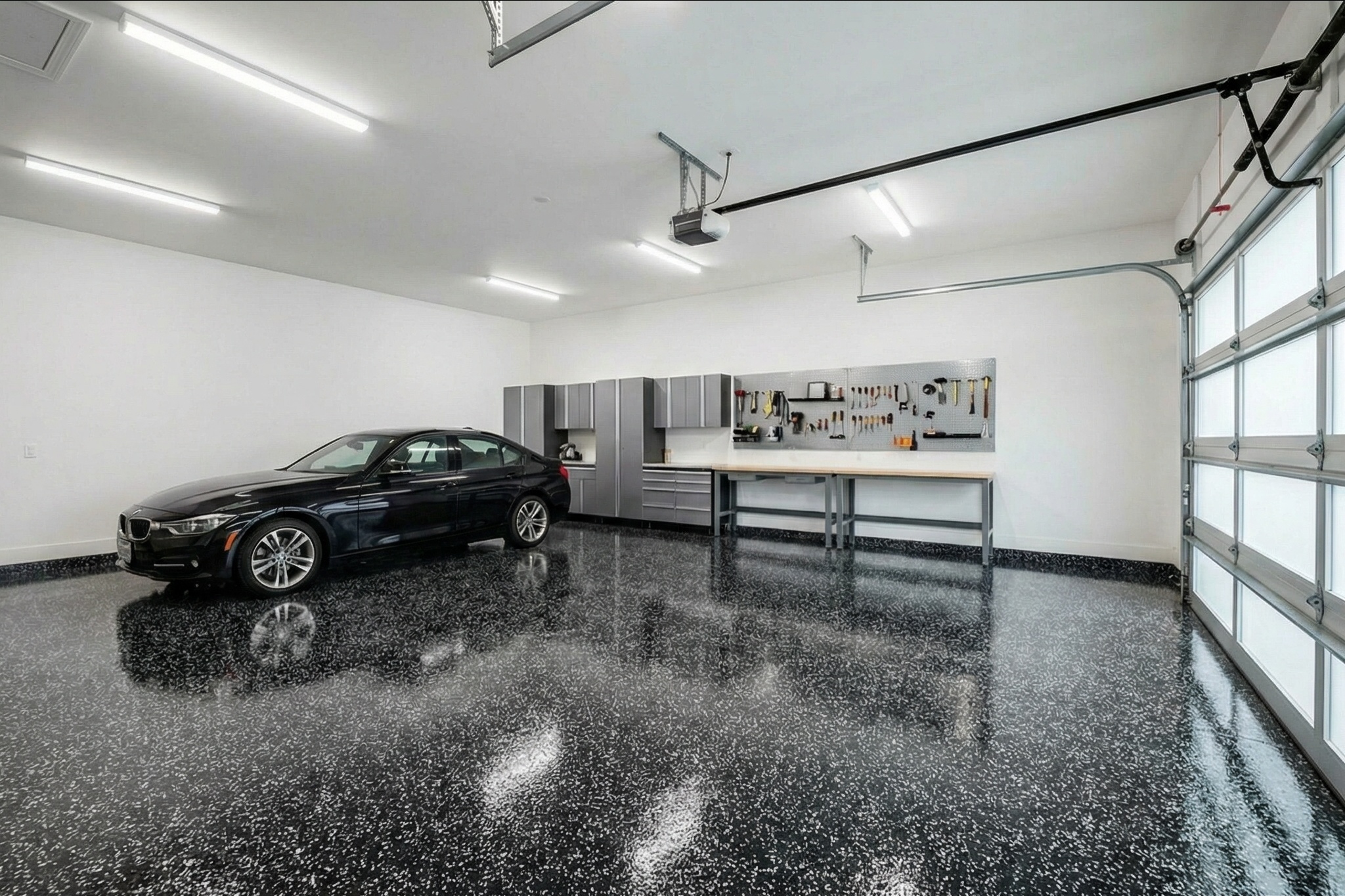
When the client pulls out their phone and shows you a photo of a metallic floor they found on Instagram, that is an epoxy job. Polished concrete cannot create flowing metallic patterns. It cannot create a domino flake broadcast. It cannot match brand colors for a commercial showroom. If aesthetics beyond natural gray are part of the conversation, epoxy is the answer.
Moisture Problem Slabs (With Mitigation)
This one is counterintuitive. Epoxy is sensitive to moisture. But with a moisture mitigation primer, epoxy can be installed on slabs that would be completely unsuitable for polishing. A slab pushing 8 lbs of moisture vapor per 1,000 sq ft cannot be polished to any meaningful standard. But a moisture mitigation primer rated for 25 lbs followed by a standard epoxy system will perform for 15+ years on that same slab.
Residential Garages
Garages are epoxy territory. Period. The chemical exposure (oil, brake fluid, deicing salt, gasoline drips) disqualifies polished concrete for any garage that will actually be used for vehicles. Epoxy resists all of those chemicals. Add a polyaspartic topcoat and you get hot tire resistance too. The decorative options make the garage feel like a finished room, which is what homeowners are paying for.
The residential garage market is also where the highest-margin epoxy work lives. A metallic garage floor at $10/sq ft on a 450 sq ft garage is $4,500 with $2,100 in labor and materials. That is $2,400 profit in two days. No polished concrete job of that size generates that kind of return.
Epoxy Coating
Pros
- Covers slab defects, cracks, patches, and staining
- Chemical resistant (oil, brake fluid, salt, solvents)
- Unlimited decorative options (flake, metallic, quartz, custom)
- Lower startup cost for contractors ($5K-15K vs $40K-100K)
- Higher margin ceiling on decorative jobs (50-60%)
- Hot tire resistant with polyaspartic topcoat
Cons
- Coating can delaminate if prep or moisture testing is inadequate
- Topcoat needs recoating every 5-10 years under heavy use
- UV-sensitive (epoxy-only topcoats yellow in sunlight)
- Not breathable (moisture vapor must be addressed before installation)
- Higher material cost per job than polished concrete
Can You Combine Them?
Yes, and hybrid approaches are becoming more common as contractors look for ways to deliver both the natural concrete aesthetic and the protection of a coating system.
Polished Base + Clear Epoxy Topcoat
Grind and hone the concrete to 400-800 grit, apply densifier, then topcoat with a thin clear epoxy or polyurethane. The concrete retains its natural look while gaining chemical resistance and stain protection. This hybrid works well for commercial lobbies and retail spaces where the client wants the polished concrete aesthetic but the floor will see food, drink, and chemical contact.
The installed cost runs $6-10/sq ft. More than standard polished concrete, less than a full decorative epoxy system. The margin is solid because the grinding work is less intensive (you are not going to 3000 grit) and the topcoat application is straightforward.
Stained Concrete + Sealed or Coated
Acid or water-based stain adds color to the concrete, then a clear sealer or epoxy topcoat provides protection. This captures clients who want warmth and color variation but not the "coated" look of a full epoxy broadcast. Earth tones from acid stain paired with a satin-finish topcoat are popular in restaurants, tasting rooms, and upscale residential basements.
Zone-Based Hybrid Systems
Large commercial spaces sometimes use both systems in different zones. Polished concrete in the showroom and customer-facing areas. Epoxy in the service bays, kitchens, or warehouse sections. The transition strip between zones is a detail that needs planning, but the result is a space where each area has the optimal floor for its function.
Pro Tip
Hybrid proposals are a strong differentiator in competitive bids. When other contractors are quoting "polished concrete" or "epoxy floor," you are quoting a floor system designed for each zone of the space. That level of specificity signals expertise and justifies a higher price. Use ShowFloor to visualize each zone separately so the client can see exactly what they are getting.
How to Recommend the Right System to Clients
Your clients are not flooring experts. They do not know the difference between polished concrete and a grind-and-seal, or between a water-based epoxy kit and a 100%-solids professional system. They know what they want the floor to look like and how much they want to spend. Your job is to translate that into the right system for their slab and their use case.
The Decision Framework
Assess the slab condition
Walk the floor. Look for cracks, patches, coatings, adhesive residue, and moisture indicators (dark spots, efflorescence). A sound, clean slab opens up both options. A damaged or contaminated slab points to epoxy.
Test for moisture
Tape a 2x2 ft plastic sheet to the slab for 24-48 hours or run a calcium chloride test. Moisture readings above 3 lbs/1,000 sq ft/24 hrs rule out standard polished concrete and require mitigation under epoxy. Do this on every job. No exceptions.
Identify the use case
Garage with vehicles? Epoxy. Commercial showroom? Either. Restaurant kitchen? Epoxy with chemical-resistant topcoat. Office lobby? Polished concrete or hybrid. Warehouse? Polished concrete for forklifts, epoxy for chemical storage zones.
Understand the aesthetic goal
Show the client examples of both finishes. If they gravitate toward natural, minimalist, industrial: polished concrete. If they light up at metallic swirls, flake patterns, or custom colors: epoxy. Let the client tell you what they want before you prescribe a system.
Present budget options
Show clear finish options during the sales conversation. For a garage: basic solid epoxy, flake broadcast, metallic. For commercial: polished to 400 grit (hone), polished to 1500+ (semi-gloss), polished with clear topcoat (hybrid). The middle option closes most often.
Showing the Difference Closes the Job
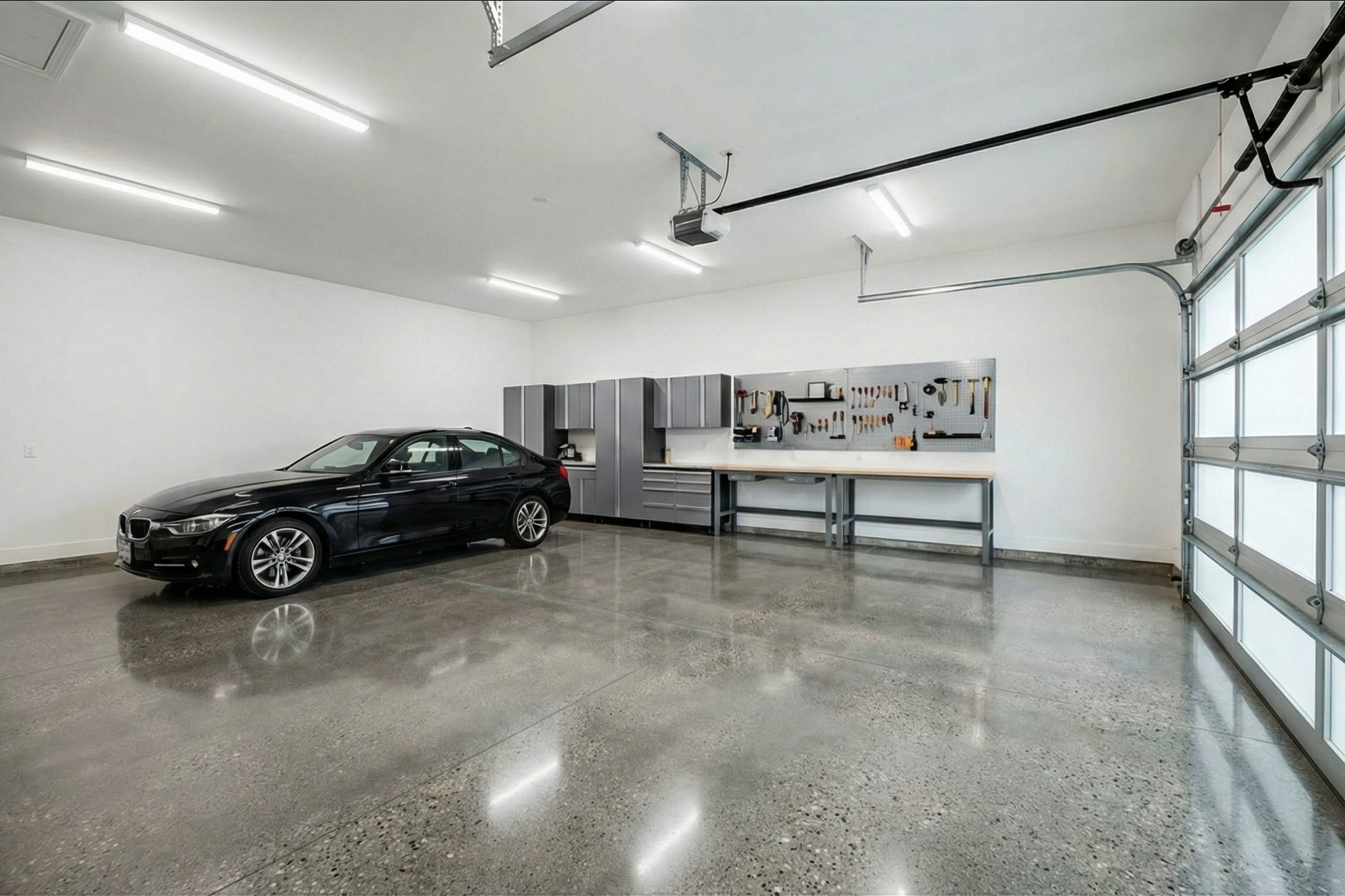
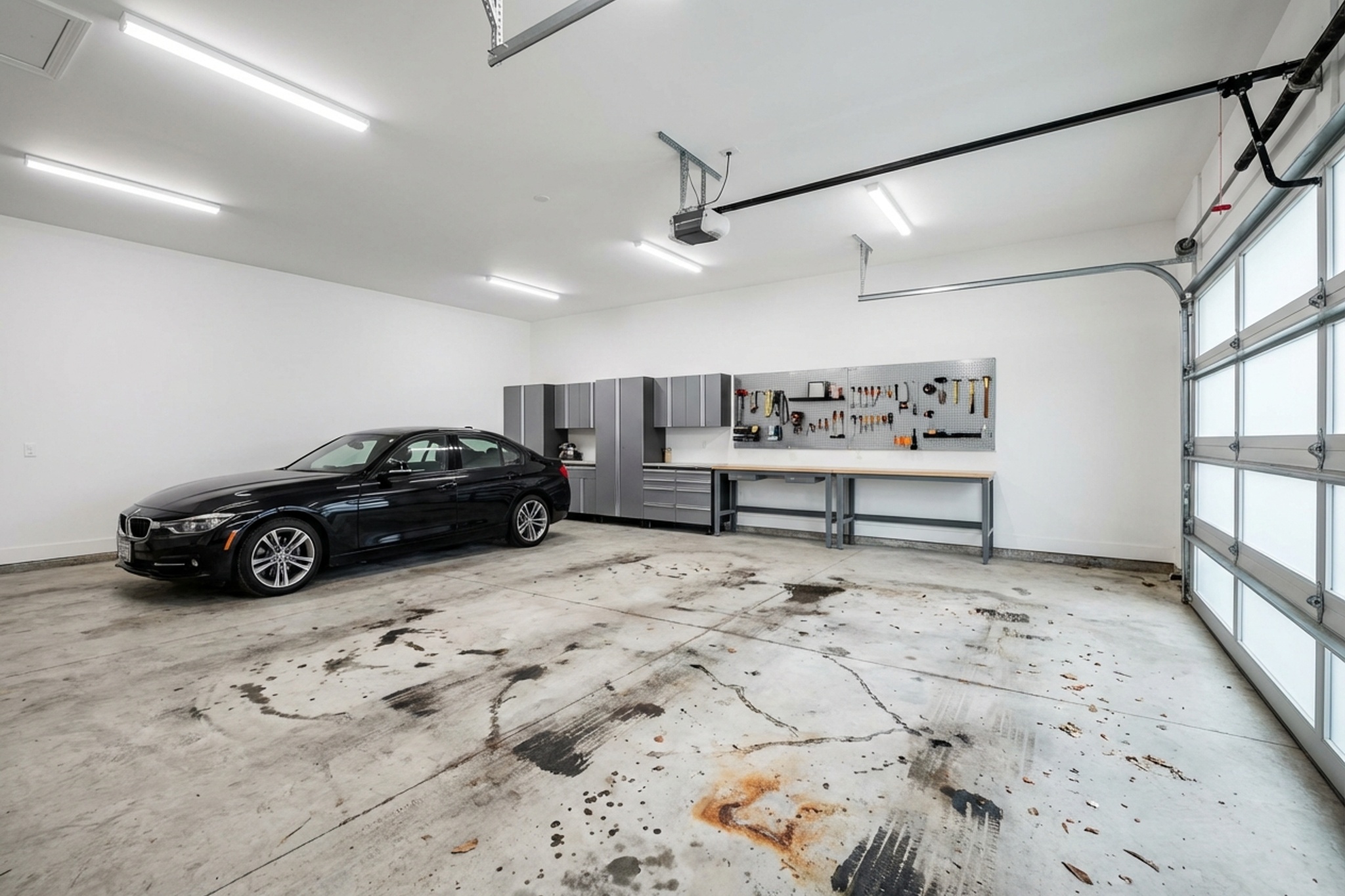
The fastest way to help a client decide between polished concrete and epoxy is to show them both options on their actual floor. Snap a photo of the space during the estimate, generate a visualization of each system, and let them compare. No brochure or sample chip delivers the same impact as seeing their specific room with a finished floor.
When a client can see the polished concrete look next to a metallic epoxy on their own garage or commercial space, the conversation shifts from "which is better?" to "I want that one." The decision makes itself.
Margin Insight
Compare both finishes in the same room photo. Explain the appearance, installation requirements, and price of each, then prepare the proposal for the chosen scope.
Featured Materials
Polished Concrete
Titanium Polish
High-gloss 3000-grit mirror finish. The signature look of premium polished concrete.
Flake Epoxy
Domino Flake
Black, gray, and white chip broadcast on charcoal base. The top-selling garage system.
Metallic Epoxy
Gunmetal Metallic
Dark silver with flowing movement. A reliable premium upgrade when paired with a flake option on garage estimates.
Quartz Broadcast
Sandstone Quartz
Natural stone texture with excellent grip. Built for workshops and high-traffic commercial.
Stained Concrete
Cola Acid Stain
Dark amber-brown stain over polished base. The hybrid approach for restaurants and retail.
Show Both Options on Their Actual Floor
Upload a photo of any space and generate visualizations for polished concrete, epoxy, or both. Let clients see the difference and decide on the spot.