Patio Floor Coatings: What Actually Lasts Outdoors
Don't put garage epoxy on a sunny patio. It yellows and chalks in UV, and the companies that make the popular kits label them indoor-only. For color, use a UV-stable polyaspartic or aliphatic polyurea with grit in the topcoat. To protect plain concrete, use a penetrating sealer. If the slab is damaged, resurface it.
Can You Put Epoxy on a Concrete Patio?
Not as the top layer, and not in direct sun. Rust-Oleum's own support page says its EpoxyShield garage kit is for indoor use only, is not UV stable, and will yellow outdoors (Rust-Oleum). Its RockSolid polycuramine kit, often sold as the tougher option, carries the same indoor-only note (Rust-Oleum). Sherwin-Williams puts it more broadly on an industrial epoxy data sheet: all epoxies will chalk and fade outdoors without a topcoat (Sherwin-Williams B67-200).
What to use instead depends on what you want the patio to look like and what the slab is doing underneath:
- You want color or a finished look, and the patio gets sun: a polyaspartic or aliphatic polyurea coating with anti-slip grit in the topcoat. These resins hold their color in UV.
- You like how the concrete looks and want it protected: a penetrating silane or siloxane sealer. You can't see it, there is no film to peel, and it is the usual defense against de-icing salt.
- The surface is cracked, patched or flaking: a cementitious overlay, or pavers laid over the slab. A coating shows every flaw underneath it.
- The patio is under a solid roof: the standard garage system (epoxy base, polyaspartic topcoat) can work, as long as the slab passes a moisture test.
Same floor, two topcoats, left out in the sun
Drag the slider or press play.
Standard epoxy
Aromatic resin
Polyaspartic
Aliphatic resin
The dividing line is chemistry. Aromatic resins discolor in sunlight: that covers most epoxies and many spray polyureas. Polycoat's data sheet for one aromatic spray polyurea says it will yellow or darken and go flat under UV, and tells installers to add an aliphatic topcoat for a colorfast finish (Polycoat). Aliphatic resins, which include polyaspartic, aliphatic polyurea and aliphatic urethane, hold their color. For a measured number, Simiron's polyaspartic data sheet reports a gloss reading of 87 to 89 after 1,000 hours in an accelerated UV chamber (ASTM G154), down from 92 to 95 when new (Simiron Polyaspartic HS).
A note on the word polyurea
Polyurea is a family, not one product. A quote that says polyurea could mean a UV-stable aliphatic product or an aromatic spray product that yellows like epoxy. Ask which one, and ask for the data sheet.
Why Epoxy Fails Outdoors (It's Not Only the Sun)
Yellowing is the failure people expect. On patios it is rarely the only problem. Three other things go wrong, and all three can take down a UV-stable coating too.
Sun: yellowing, then chalking
UV breaks down the surface of an aromatic epoxy. First it picks up an amber cast, most visible on light colors and clear coats. Then it loses its gloss and turns powdery. One GarageJournal member described epoxy that ran about 10 inches past the garage door: after seven years, the strip in the sun had gone white while the floor inside stayed gray (GarageJournal). That is one owner's floor, not a test, but it is the pattern the data sheets describe.
Moisture pushing up from underneath
A patio is a slab poured on the ground, usually with no plastic vapor barrier under it, and it gets rained on. Water vapor moves up through the concrete and pushes against any film on top. Rust-Oleum's EpoxyShield page warns its coating will crack and peel from repeated exposure to moisture. Simiron's polyaspartic data sheet says a moisture barrier must be in place under slabs on grade, because seasonal changes in ground moisture can push vapor through no matter what a test showed before coating. Deco-Crete's sheet says the same thing: a passing moisture test is not a guarantee without a vapor barrier (Deco-Crete Polyaspartic 90).
This is why porch paint and patio coatings peel in patches rather than wearing evenly. Homeowner forums are full of the same story: paint on a porch or pool deck that flakes after one season, gets scraped and repainted, and flakes again. The usual advice in those threads is to grind the surface and look for the moisture, not to apply another coat (TroubleFreePool).
Heat during the install: bubbles and pinholes
Concrete is full of tiny air pockets. When the sun warms a slab, that air expands and rises through the wet coating, leaving pinholes and craters. Sherwin-Williams tells installers not to put down its Resuflor epoxy when the slab is above 90°F, and to coat while the slab temperature is falling, which usually means later in the day (Sherwin-Williams). A south-facing patio in July can pass 90°F well before lunch.
Prep that stops at the pressure washer
Coatings grip a surface that has been opened up mechanically, usually with a diamond grinder. Deco-Crete's polyaspartic sheet calls for a concrete surface profile of CSP 2 or rougher, which a pressure washer won't produce. Old sealer, paint, or a weak, dusty top layer all have to come off first. A bid that skips grinding will usually be the cheapest one, and the gap tends to show up later as peeling.
Covered is not the same as shaded
Epoxy under a solid roof is a different job from epoxy in the open. But an open pergola, a screen porch that catches low western sun, or a roof that covers half the slab still puts direct light on the floor for hours. Before you call a patio covered, check where the sun actually lands at 4 pm in summer.
Which Coating Fits Your Patio?
Answer six questions about the slab. The tool follows the same rules as the rest of this guide and gives you a starting system, what to ask an installer for, and a ballpark price from the sources cited below.
Best fit for this slab
Polyaspartic or aliphatic polyurea coating, with anti-slip grit
The UV-stable version of a garage-style coating: solid color or flake, and it does not yellow.
Why
- Direct sun rules out epoxy as the top layer. Polyaspartic is aliphatic, so it holds its color in UV.
Ask for, or watch for
- Ask for a moisture test before anything goes down, and for the product’s limit in writing.
- Anti-slip aggregate in the topcoat, written into the quote with the grit size.
- Choose a lighter color. Dark coatings in full sun get hot enough to be unpleasant barefoot.
Skip
Garage-floor epoxy as the top layer. In direct sun it yellows and chalks, and the maker of the best-known kit says it is for indoor use only.
Ballpark: About $4 to $9 per sq ft (Bob Vila), more with heavy grinding or repairs
A starting point for the conversation with an installer, not a site inspection. Moisture tests, the existing surface and local prices can change the answer.
When answers pull in different directions, water wins. A patio that puddles, slopes toward the house, or grows white powder needs that handled before any finish is worth paying for.
Concrete Coatings for Patios, Compared
These are the finishes used on existing outdoor slabs, with national installed price ranges from the sources named in each row. Your price will move with slab condition, access, and how much grinding and repair the job needs.
Patio finishes for existing concrete
| Finish | What it looks like | Installed cost | Upkeep | Watch out for |
|---|---|---|---|---|
| Penetrating sealer (silane or siloxane) | No change; concrete stays matte | $1.35-2.50 for professional sealing (HomeAdvisor) | Lasts 10+ years per Concrete Network | No color change; blocks any later stain or coating until ground off |
| Acrylic sealer | Wet look or satin; can be tinted | $0.85-1.15 (Bob Vila) | Reseal every 1-3 years (Concrete Network) | Gets slick when wet; salt pools attack it |
| Acid stain plus sealer | Mottled earth tones in the concrete itself | $2-6 basic designs (HomeAdvisor) | Sealer upkeep only | Limited colors; patches and old sealer show through |
| Porch and patio paint | Solid color film | $2-5 (Concrete Network) | Repaint often | Peels over damp, sealed or dusty concrete |
| Polyaspartic or aliphatic polyurea | Solid color, flake or clear | $4-9 (Bob Vila) | Low; can be recoated | Short working time; moisture and humidity limits; needs grit |
| Cementitious overlay | New surface: smooth, textured or stamped | $3-7 basic, $7-12 mid-range (Concrete Network) | Needs a sealer | Unrepaired cracks come back through |
| Pavers over the slab | Brick, concrete or stone units | $8-25 installed (HomeAdvisor) | Joint sand, occasional reset | Raises the floor height at door thresholds |
Penetrating sealers
Silane and siloxane sealers soak into the concrete and repel water from inside the pores instead of forming a film on top. Nothing sits on the surface to peel, yellow or get slick. Foundation Armor rates its SX5000 at up to 7 to 10 years before a recoat (Foundation Armor). The trade-off: the patio still looks like concrete, stains and all. A sealed slab also won't take a stain or coating later until the sealer is ground off.
Stains
Acid stain reacts with the lime in the concrete and leaves permanent, mottled color in earth tones. Water-based stains come in more colors but sit closer to the surface and need resealing more often. Both need bare, unsealed concrete, and both show the slab's history: patches and old repairs take stain differently from the original concrete.
Overlays
An overlay is a thin layer of polymer-modified cement over the old slab: a smooth microtopping, a spray-on knockdown texture, or a stamped pattern. It is the right answer when the surface is spalled, patched or ugly enough that a coating would just frame the damage. The slab underneath has to be sound, and structural cracks need repair first or they come back through.
Porch and patio paint
It is the cheapest way to change the color, and on forums it is also the most common complaint: a thin film that peels after one winter or one wet season, usually because it went over sealed, dusty or damp concrete. Paint is fine on a covered porch you are willing to repaint. On an open patio, budget for doing it again.
Concrete Patio Coating Ideas That Work Outside
Most patio inspiration photos are garage floors or freshly coated slabs shot on day one. These looks hold up on an outdoor slab because they work with heat, dirt and sun instead of against them.
- Tan, gray or stone-toned flake blends. They hide pollen, grit and the texture of anti-slip aggregate, and they stay cooler than charcoal or black.
- Solid color in a light shade, with a satin or matte topcoat if the product offers one. Less glare from the house on a sunny afternoon, and scuffs show less than on high gloss.
- Acid stain with saw-cut lines, scored into a tile or flagstone pattern. All the color is in the concrete, so there is no film to peel.
- A spray-knockdown or stamped overlay where the old surface is rough. The texture is what makes it grip.
- A border in a second color around the edge, with the color change lined up on a control joint so the joint stays hidden.
- Colors pulled from the house itself: roof, trim or stone veneer. A patio is seen against the house, not on its own.
For photos of these finishes on real patios, see the patio floor coating ideas gallery. If you are weighing polyaspartic against epoxy for a garage at the same time, the polyurea vs epoxy guide and the garage floor coating options guide cover the indoor side.
Polyaspartic on a Patio: What the Data Sheets Say
Polyaspartic is the coating most people mean when they ask about an epoxy patio. Sherwin-Williams says most polyaspartic floor coatings are suitable for outdoor use (Sherwin-Williams). It cures fast enough to walk on the same day. That speed is also its weak point: it gives the crew very little time to work, and less in heat and humidity.
What three polyaspartic data sheets require
| Requirement | Simiron Polyaspartic HS | Deco-Crete Polyaspartic 90 | Versatile 5108 |
|---|---|---|---|
| Temperature | Air and surface 35-85°F; material 60-85°F | Surface 40°F minimum; best suited 60-90°F | Air and surface above 35°F |
| Humidity | Working time 25 min-2 hrs at 20% RH, 14-70 min at 80% RH (by version) | Not at 85% RH or above; surface 5°F above dew point | Below 65% RH |
| Slab moisture limit | 3 lbs (ASTM F1869) or 75% RH (ASTM F2170); barrier required on grade | 3 lbs (ASTM F1869) or 80% RH (ASTM F2170) | Moisture primer on grade at 3 lbs or more |
| Recoat | As soon as the first coat is tack free | 15-20 min pot life | 4-8 hour recoat window |
| Wet slip rating | DCOF 0.63 over full flake | DCOF above 0.42 level, above 0.45 inclines | Not listed |
Sources: Simiron, Deco-Crete, Versatile.
Three things in that table matter for a patio. Humid summer mornings are often off limits, and dew on the slab can rule out an early start. The moisture limits are the same numbers indoor floors use, but an outdoor slab is wetter more of the time. And recoat windows are short: Neogard's polyaspartic has to be recoated within 24 hours, after which the surface must be sanded before the next coat (Neogard). A rain delay between coats is a real cost on an outdoor job.
Install to the data sheet, not the ad
You will see polyaspartic advertised as going down in almost any weather. The sheets above say roughly 35 to 90°F with humidity limits. Ask your installer which product they are using and check its sheet. That is also the first thing a manufacturer asks about when a floor fails.
What about an epoxy base with a polyaspartic topcoat?
That is the standard garage system, and it is common on covered patios. Westcoat's spec for its EC-36 epoxy says interior use only unless it is protected by a UV-resistant coating (Westcoat). Under a solid roof, that protection is enough for most jobs. In full sun, the risk is where the topcoat wears thin, at a door, under a grill or along a walking path, which leaves the epoxy below exposed. Many installers simply go polyaspartic or aliphatic polyurea for every coat on open patios. Ask which way a bid is built.
Can you DIY it?
The big-box garage kits are not built for this: both Rust-Oleum kits above are labeled indoor-only. Professional polyaspartic is sold to the public, but a 15 to 20 minute pot life on a hot slab leaves no room for learning. If you DIY a patio, a penetrating sealer or a stain is the forgiving choice.
Will a Coated Patio Be Slippery or Hot?
Slippery when wet
In the homeowner threads we read for this guide, a slippery surface was the most common regret, ahead of yellowing. One Reddit poster called the polyaspartic patio a concrete company coated 18 months earlier one of their worst home decisions because it is slick when wet (r/HomeImprovement). A Florida owner described nearly falling on dew on a screened lanai that had grit in its epoxy, and now keeps a rug over it (Talk of the Villages). Dew counts. A patio can be wet at 7 am on a dry day.
Slip resistance is measured as wet DCOF (dynamic coefficient of friction). The 0.42 figure you may see quoted is the tile industry's threshold for level interior floors that get wet. For exterior wet floors the standard sets no number and leaves it to the manufacturer (TCNA). Sherwin-Williams says 0.55 or higher is generally accepted for exterior wet floors (Sherwin-Williams).
The fix is aggregate in the topcoat. Westcoat's aluminum oxide spec, for example, broadcasts 36 or 60 grit into the topcoat at about 4 to 7 lbs per 1,000 sq ft and back-rolls it (Westcoat CA-33). Coarser grit grips better and is harder to sweep and rougher on bare feet, so there is a real trade-off.
Test the sample wet
Ask the installer for a sample board with the same flake, topcoat and grit they plan to use. Pour water on it, then step on it in bare feet or socks. Ask for the grit size and rate in writing on the quote.
Hot underfoot
Dark surfaces in full sun get hot enough to hurt. A UNLV study of pavement burns measured pavement at 147°F on a 111°F day and found second-degree burns can happen within two seconds of contact (UNLV). Lawrence Berkeley National Laboratory puts new gray concrete at 30 to 50 percent sunlight reflected, and aged concrete at 20 to 35 percent (Berkeley Lab). A charcoal or black coating reflects less than either. Solomon Colors, a concrete pigment maker, estimates that raising a surface's solar reflectance index from about 35 (plain gray concrete) to about 56 keeps it roughly 10 to 25°F cooler (Solomon Colors).
In practice: on a patio that gets afternoon sun, pick tans, light grays and stone blends over charcoal and black. A black floor also shows every speck of pollen and dust, a complaint that shows up in forum threads about dark outdoor floors. If you have kids or dogs, stand on a dark sample in July before you sign.
Cold Winters and De-icing Salt
Freeze-thaw damage starts in the concrete, not the coating. Water soaks into the surface, freezes, expands, and pops off the top layer, which is called scaling. The National Ready Mixed Concrete Association says de-icers make it worse by keeping the surface wetter and adding freeze-thaw cycles (NRMCA CIP 2). Its guidance for homeowners is specific:
- Don't use de-icers on concrete in its first winter.
- Calcium chloride and sodium chloride are considered acceptable. Never use ammonium nitrate, ammonium sulfate or magnesium-based de-icers, which NRMCA says destroy concrete surfaces.
- Protect the slab with a breathable silane or siloxane sealer, applied when the concrete is reasonably dry. Late summer is ideal.
That is why the chooser above leans toward penetrating sealers in salt country. Products like Euclid's Baracade Silane 40 are tested for exactly this: the data sheet reports a rating of 0, meaning no scaling, in the ASTM C672 salt-scaling test (Euclid Chemical).
Film coatings can work in cold climates, but winter finds every weak spot in the bond. In one GarageJournal thread, a polyaspartic topcoat peeled about a year after install, mostly where salty snowmelt sat for weeks; the installer redid it under warranty (GarageJournal). On a coated patio in a cold climate, insist on grinding rather than washing, make sure water drains off instead of pooling, and shovel before you salt. Concrete Network also warns that a sealer applied over too much moisture is likely to fail, turn white or peel, and says not to seal when the surface is within 5°F of the dew point (Concrete Network).
Pool Deck Coatings
Pool decks add chemistry, bare feet and constant splash to everything above. The pool and spa code requires decks to be slip resistant and cleanable (ISPSC 306), and the industry default reflects that: a light-colored, textured cement finish. Kool Deck, the best-known brand, has been around since 1962; its maker says it lowers the surface temperature noticeably, is unaffected by normal pool chemicals, and that its darker colors run warmer (Mortex).
Saltwater pools
Salt changes the sealer choice. Contractors interviewed by Concrete Decor said salt attacks sealers and causes them to delaminate; one reported acrylic sealers flaking within four to five months, and the chemists quoted preferred penetrating silane or siloxane sealers around salt pools (Concrete Decor). Rinsing splash-out with fresh water helps any finish.
Coating an old deck
Peeling pool decks are a staple of pool forums, and the advice is consistent: the old coating usually failed because it went over unprepared concrete, and anything new will fail the same way unless the deck is ground down first. One Oklahoma owner who inherited a peeling deck was quoted $2,500 just for removal (TroubleFreePool). That is one quote, but removal is a real line item: Concrete Network puts it at $2 to $6 per sq ft, with basic pool deck resurfacing at $4 to $8 and decorative overlays at $6 to $12 or more (Concrete Network).
Some installers put polyaspartic with grit on pool decks. A Virginia owner on TroubleFreePool shared a quote of about $7 to $8 per sq ft with a 15-year warranty for a 1,000 sq ft deck, and most replies worried about slipping (TroubleFreePool). If you go that way, get the manufacturer's approval for pool-deck use in writing, test a wet sample barefoot, and choose a light color.
Six Checks Before You Get Quotes
You can do most of these yourself in an afternoon. They tell you which finishes are realistic, and they make it easier to spot an installer who skips them.
Watch where the sun lands
Check the patio at 9 am, 1 pm and 4 pm on a sunny day. Full sun on any part of the slab rules out epoxy as the top layer and pushes you toward lighter colors.
Look for an old sealer
Drip water on a few spots. W.R. Meadows says if the drops bead up and stay beaded for five minutes, a sealer is still working; if they spread to about the size of a half dollar, the concrete is bare (W.R. Meadows). Stain and coatings need bare concrete, so a sealed slab means stripping or grinding first.
Tape down a sheet of plastic
The plastic sheet test (ASTM D4263) is a quick screen for moisture: tape an 18 by 18 inch sheet down on all edges. KTA-Tator says leave it at least 16 hours, ideally 22 to 26 (KTA); Tnemec says at least 24 (Tnemec). Darkened concrete or droplets under the plastic mean moisture is coming up. A coating installer should follow with a measured test (ASTM F1869 or F2170), and even those only describe the slab on the day of the test.
Read the white powder
Efflorescence, the white powdery deposit on some patios, is salt carried to the surface by water moving through the slab (Concrete Network). It is a moisture warning. Heavy efflorescence points toward breathable finishes like penetrating sealers and stains, not films.
Watch where the water goes
Hose the patio or look after rain. Paved surfaces within 10 feet of the house should slope at least 2 percent away from it, about a quarter inch per foot (InterNACHI). A coating won't fix a patio that puddles or drains toward the door.
Sort cracks from joints
Control joints are the straight cuts placed on purpose so the slab cracks there instead of somewhere random. They should stay working: coated into and back out of, or filled with a flexible sealant, never bridged with rigid coating. Random cracks get repaired. Cracks that are wide or offset, with one side higher than the other, need a concrete contractor before a coating contractor.
What a Good Patio Coating Quote Spells Out
Two quotes that both say patio epoxy, flake, $X can describe very different floors. A quote you can compare names these things:
- The product for each coat (base, flake, topcoat), and that each is rated for exterior use. Ask for the data sheets.
- How the surface is prepared: diamond grinding or shot blasting, not just pressure washing.
- Moisture test results, and the product's limit they were compared against.
- Anti-slip aggregate: type, grit size and rate.
- How control joints, expansion joints and cracks will be handled.
- The temperature, humidity and dew point window they will install in, and what happens if it rains between coats.
- Warranty terms, especially whether peeling caused by slab moisture is covered. Moisture is a common cause of patio coating failures, so read that clause before you sign.
For contractors
Outdoor jobs are harder to sell from a sample board than garages. The customer is often choosing between a coating and something else entirely, like pavers, and they see the patio from the kitchen window. Showing their own patio in two or three finishes, and writing the chemistry, grit and joint plan into the proposal, separates your bid from the one that just says patio epoxy.
Sources
Manufacturer data sheets were read in their current published versions as of October 2026. Always check the sheet for the exact product on your job. Prices are national ranges from the cost guides named; forum stories are individual owners' reports, not tests.
- Manufacturer guidance: Rust-Oleum EpoxyShield, Rust-Oleum RockSolid, Sherwin-Williams B67-200, Sherwin-Williams on outgassing, Sherwin-Williams on polyaspartics, Sherwin-Williams on slip resistance
- Data sheets: Simiron Polyaspartic HS, Deco-Crete Polyaspartic 90, Versatile 5108, Neogard 70869/70819, Polycoat Polyeuro 5502, Westcoat EC-36, Westcoat CA-33, Euclid Baracade Silane 40, Foundation Armor SX5000, Mortex Kool Deck
- Standards and industry bodies: NRMCA CIP 2, Scaling Concrete Surfaces, TCNA on DCOF, ISPSC 306, InterNACHI on grading, W.R. Meadows, KTA-Tator, Tnemec
- Heat: UNLV pavement burn study, Berkeley Lab cool pavements, Solomon Colors
- Costs: HomeAdvisor sealing, HomeAdvisor staining, HomeAdvisor pavers, Bob Vila polyaspartic, Bob Vila sealing, Concrete Network overlays, Concrete Network restoration, Concrete Network pool decks
- Trade press and forums: Concrete Decor on salt pools, Concrete Network on sealer moisture, Concrete Network on efflorescence, GarageJournal (1, 2), TroubleFreePool (1, 2), r/HomeImprovement, Talk of the Villages
See the finish on your own patio first
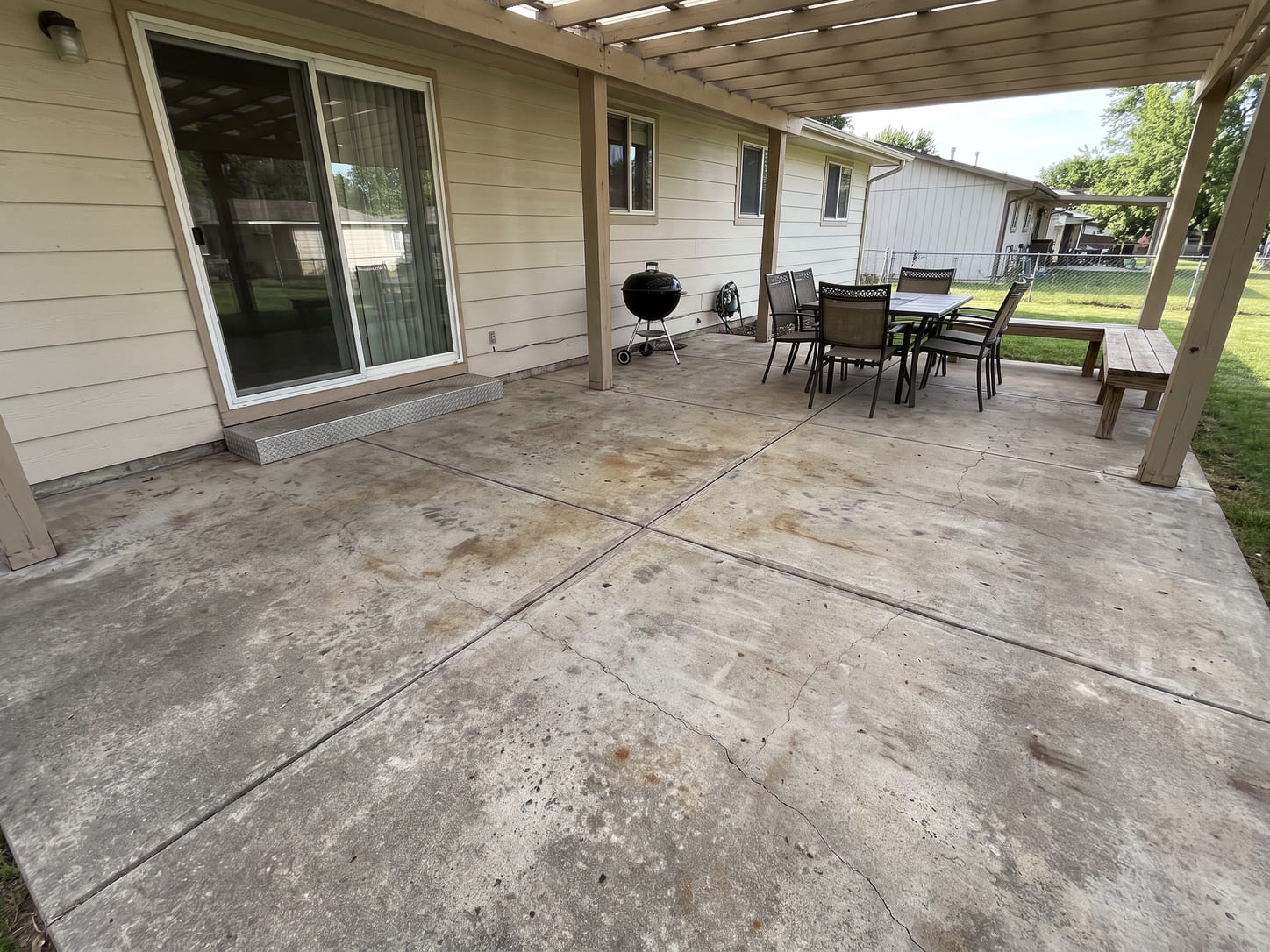
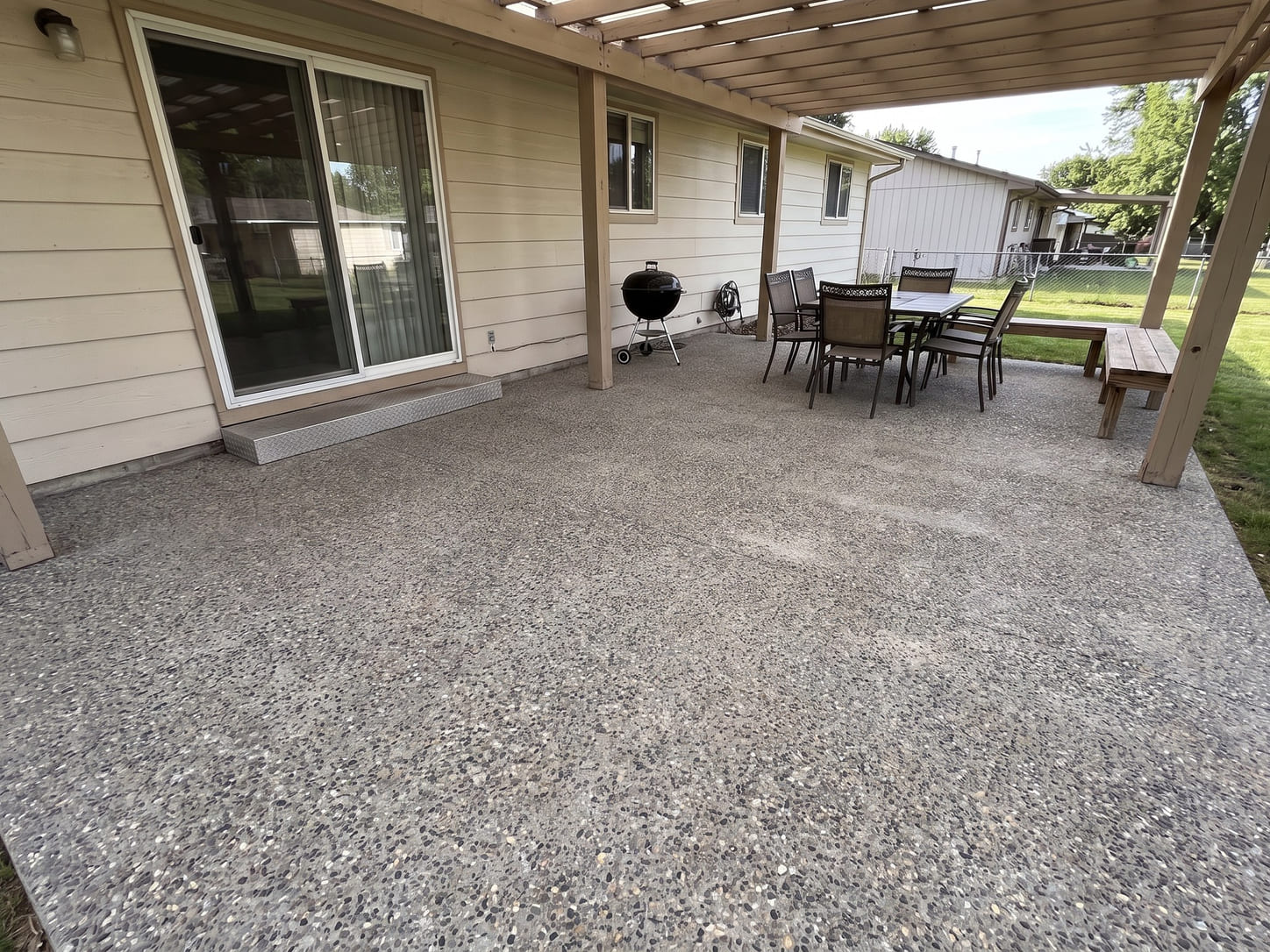
ShowFloor turns a photo of a patio into a realistic preview of the finish you're considering, so you can compare a stain, a flake coating and an overlay on the real slab before anyone starts grinding.