Epoxy Flooring Cost per Square Foot in 2026
Installed price ranges for every system, metallic included, the line items that move a quote, and how to present priced options on the customer's own floor.
Epoxy Flooring Cost per Square Foot by System
$3–$12/sq ft
Installed Price Range
Solid color to metallic
$1,200–$6,000
Two-Car Garage
400–500 sq ft, solid to metallic
Up to $15/sq ft
Multi-Color Metallic
Detailed designs and small rooms
Most residential epoxy work prices between $3 and $12 per square foot installed. Where a job lands in that range depends on three things: the system, the condition of the slab, and how much detail work the room needs. Price per square foot is the number customers use to compare quotes, so it is the number to get right first.
Installed Cost per Square Foot by System (2026)
| System | Materials | Labor & Prep | Installed | Typical Lifespan |
|---|---|---|---|---|
| Solid color epoxy | $0.50–$1.50 | $2.50–$3.50 | $3–$5 | 5–10 years |
| Flake broadcast | $1.50–$3.00 | $2.50–$4.00 | $4–$7 | 10–15 years |
| Quartz broadcast | $2.00–$4.00 | $3.00–$6.00 | $6–$10 | 15–20 years |
| Metallic epoxy | $3.00–$5.00 | $5.00–$7.00 | $8–$12 (to $15) | 15–20 years |
| Full polyaspartic | $2.50–$4.50 | $3.00–$7.50 | $5–$12 | 15–20+ years |
Labor and prep are most of the price on every system. On a 450 sq ft flake garage, contractor-priced material (primer, base coat, full-broadcast flake and a polyaspartic topcoat) runs about $675 to $1,350. The rest of the invoice is grinding, repairs, application time, equipment, overhead and margin. That is why two quotes for the same product can sit thousands of dollars apart: they are rarely quoting the same prep.
Good to Know
Every range on this page assumes diamond grinding or shot blasting, a primer, a base coat and a polyaspartic or polyurethane topcoat. Take out the grinding or the topcoat and the price drops, and so does the lifespan.
What a Garage Costs by Size
Square footage times the system rate gets you close, but the rate itself moves with size. Mobilization, grinder setup, edge work and the crew's minimum day cost about the same on a one-car garage as on a three-car, so small rooms land at the top of the per-foot range and large ones near the bottom.
Installed Cost by Garage Size (2026)
| Garage | Sq Ft | Solid Color | Flake | Metallic |
|---|---|---|---|---|
| 1-car | 200–300 | $600–$1,500 | $800–$2,100 | $1,600–$3,600 |
| 2-car | 400–500 | $1,200–$2,500 | $1,600–$3,500 | $3,200–$6,000 |
| 3-car | 600–800 | $1,800–$4,000 | $2,400–$5,600 | $4,800–$9,600 |
| 4-car / oversized | 900–1,100 | $2,700–$5,500 | $3,600–$7,700 | $7,200–$13,200 |
To rough out a job from a photo and a tape measure: multiply the floor area by the system's per-foot range, then add the line items covered below for repairs, moisture and coating removal. Columns, steps and jogs in the layout add 10–20% to labor.
What Drives the Price of Each System
Solid color ($3–$5/sq ft)
A pigmented base over primer, finished with a clear topcoat. It is the fastest system to install and the easiest to keep clean, with material at $0.50 to $1.50 per square foot. It fits utility garages, rentals, basements that need a clean finish on a budget, and commercial bays where protection matters more than looks. A 450 sq ft garage runs about $1,350 to $2,250.
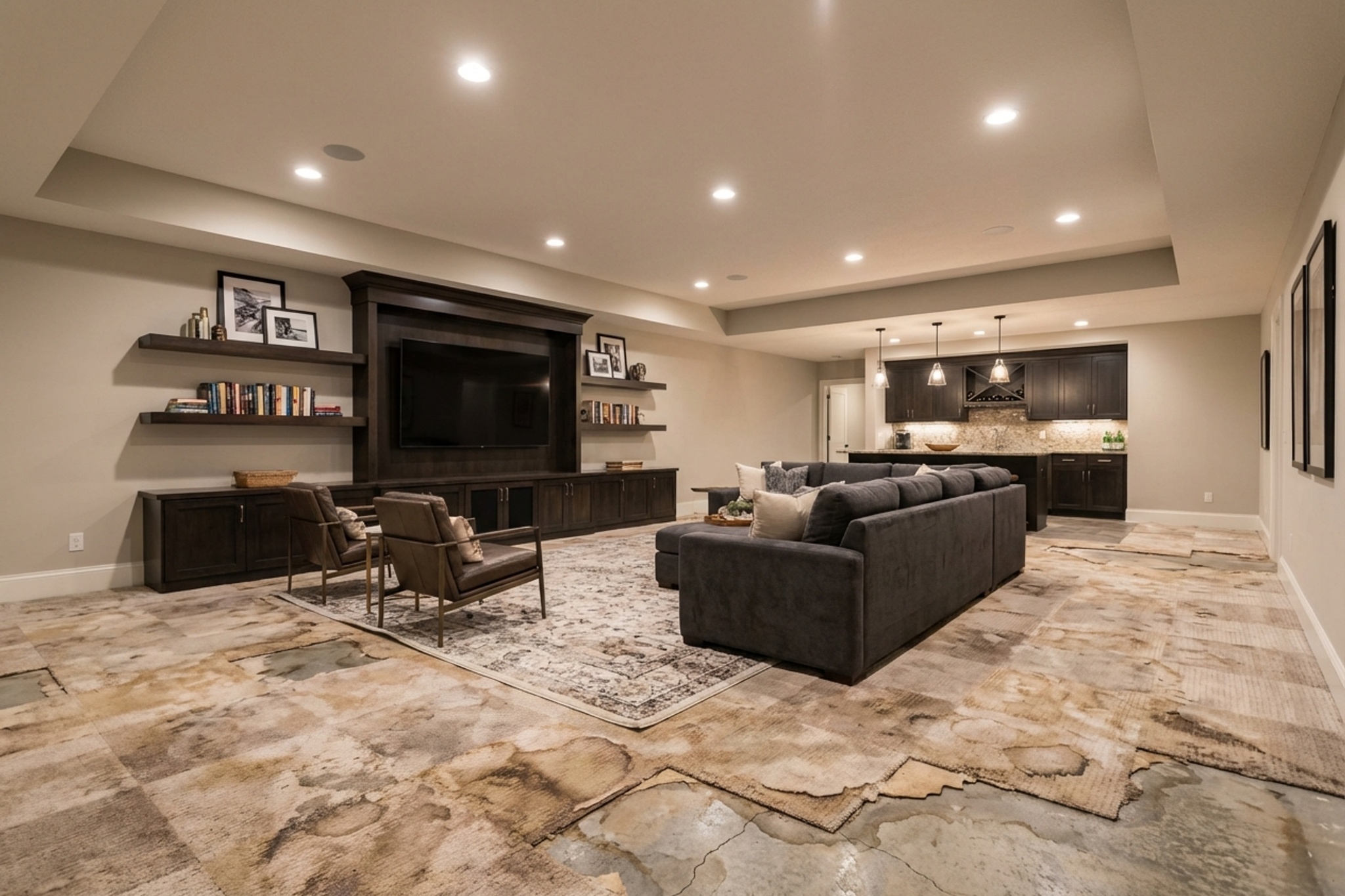
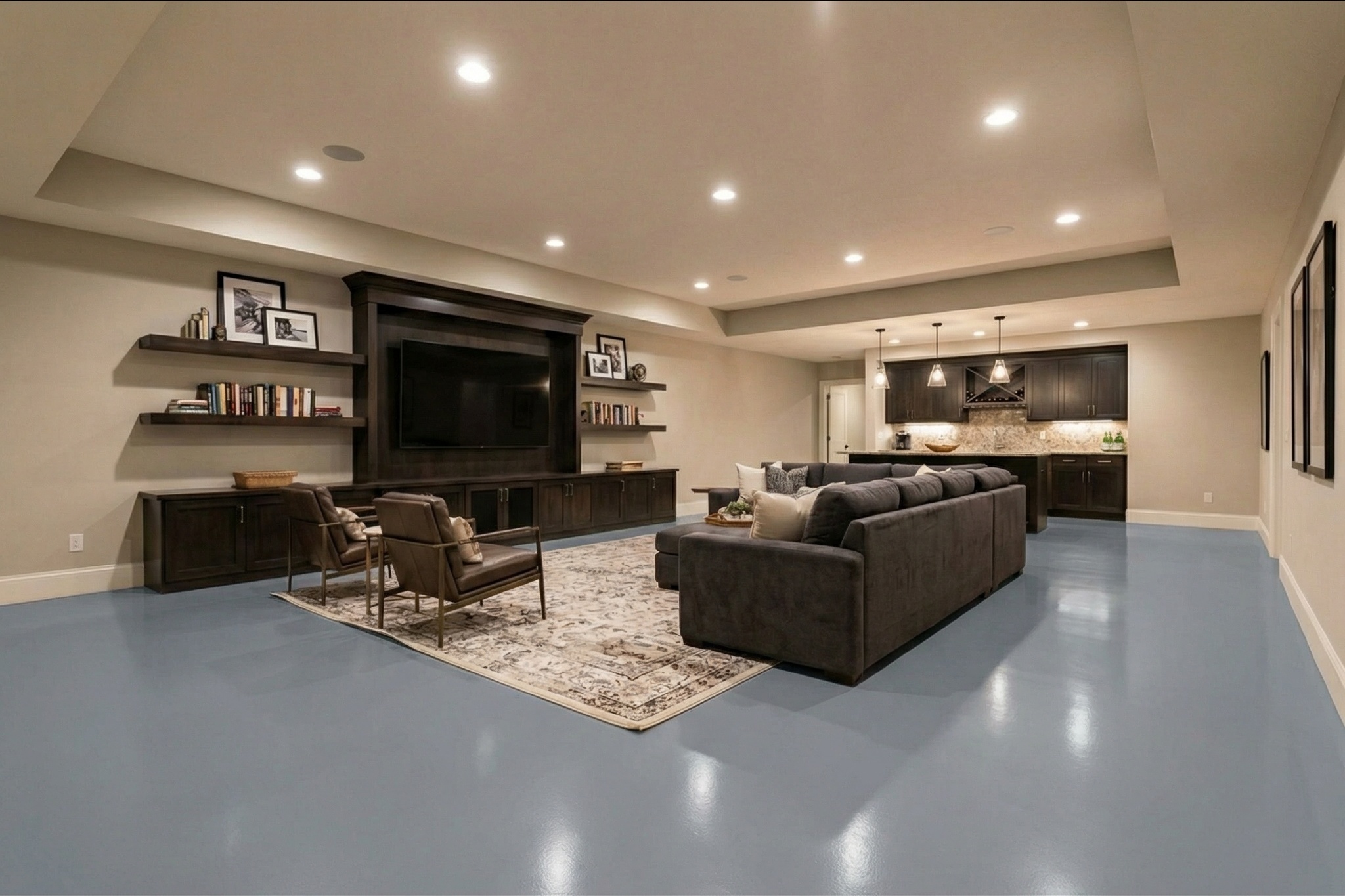
Flake broadcast ($4–$7/sq ft)
Vinyl chips broadcast into the wet base coat. Flake hides small slab imperfections, adds grip and is the system most garage customers expect. Material runs $1.50 to $3.00 per square foot. Full broadcast, where the chips cover the base completely, costs $1 to $2 more per square foot than partial broadcast and uses two to three times as much chip. A two-car garage with full broadcast and a polyaspartic topcoat runs about $1,800 to $3,150.
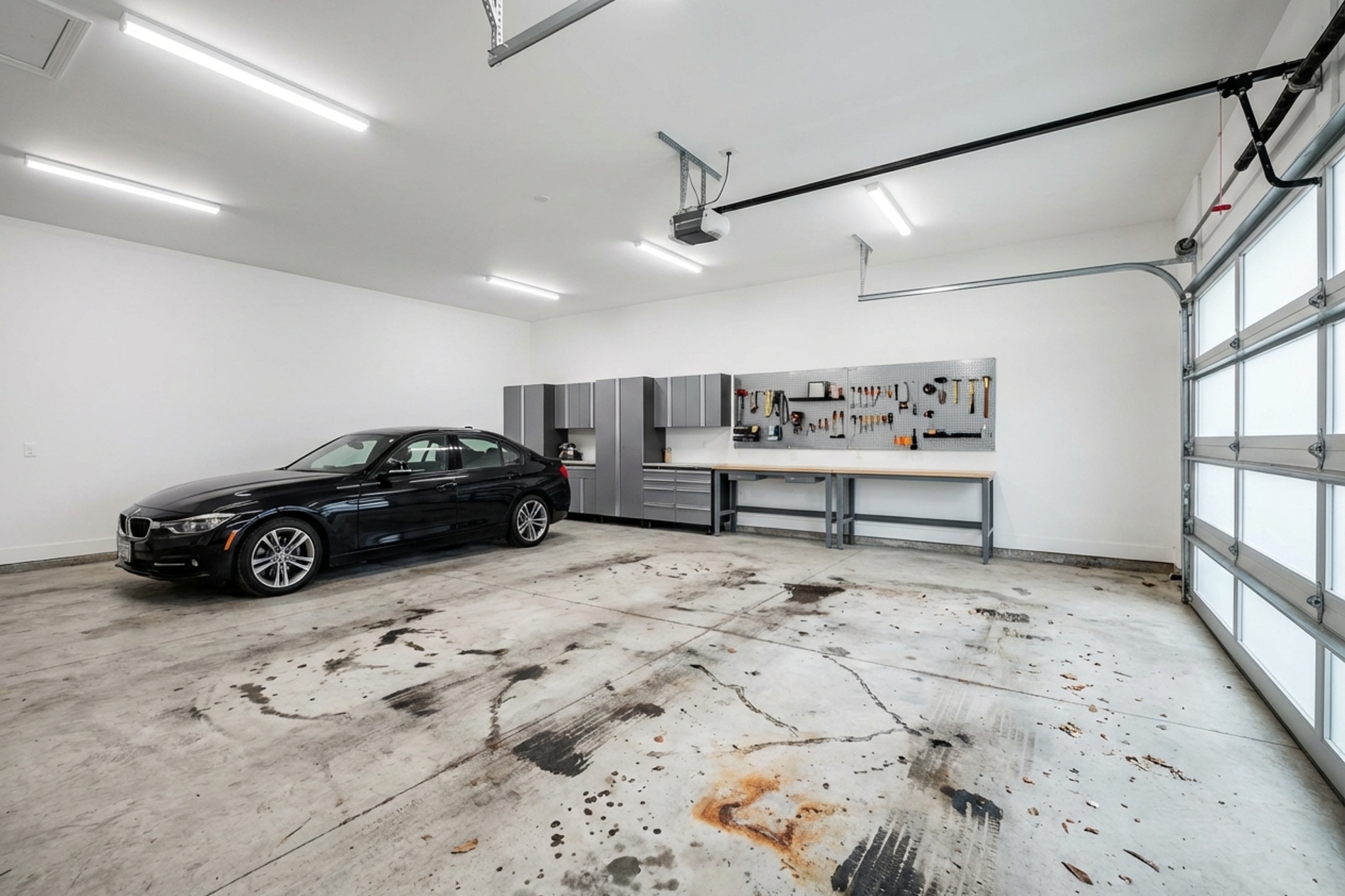
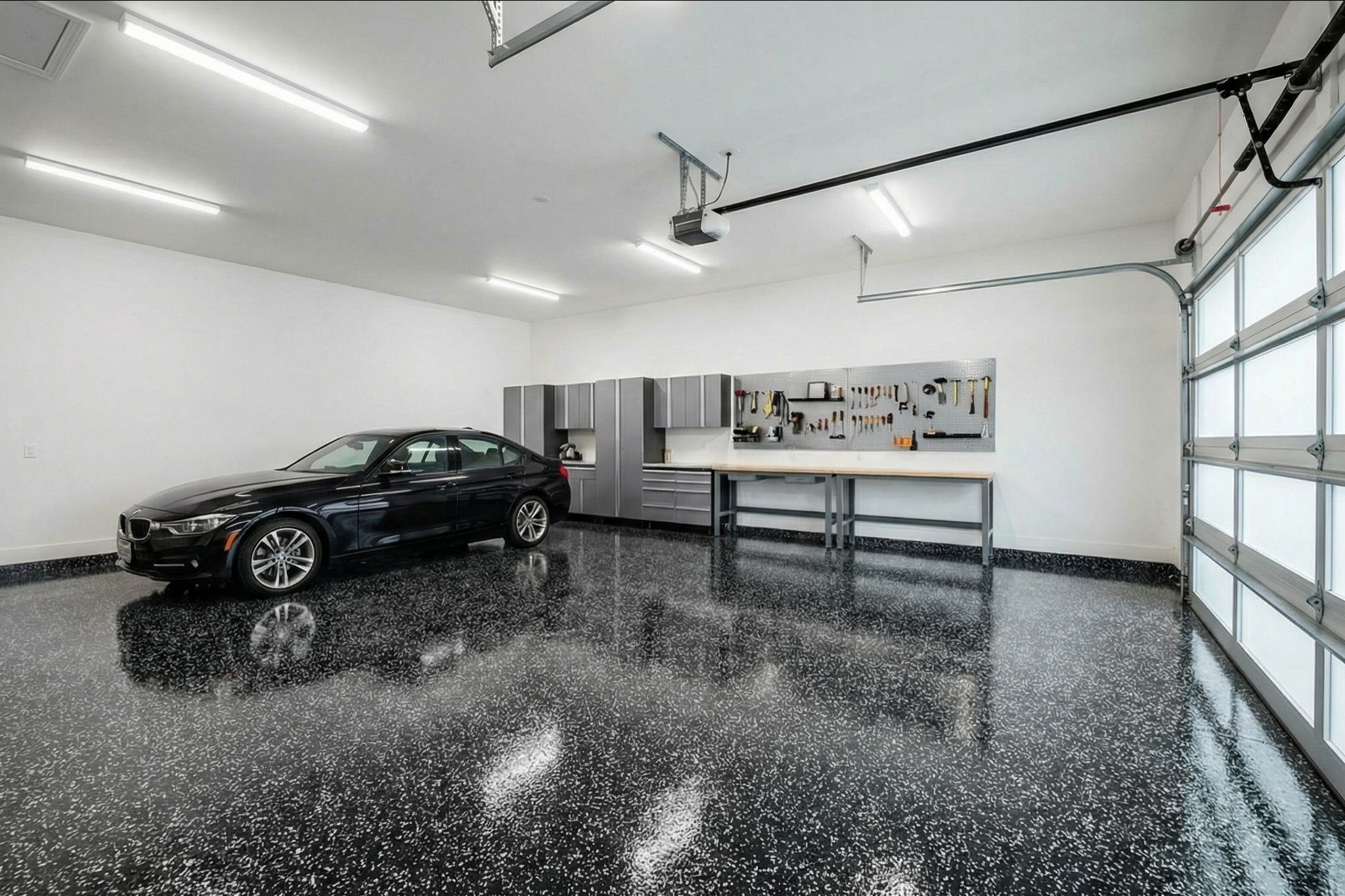
Quartz broadcast ($6–$10/sq ft)
Colored quartz granules in place of vinyl chips, usually built in more than one broadcast layer. The surface is harder and grippier than flake and stands up to road salt, snowmelt, rolling tool chests and dropped tools, which makes it the usual pick for workshop garages and cold-climate markets. Material runs $2 to $4 per square foot. A two-car garage lands around $2,700 to $4,500.
Polyaspartic and hybrid systems ($5–$12/sq ft)
Polyaspartic cures in hours, stays clear in sunlight and resists hot tire pickup. A full polyaspartic system runs $5 to $12 per square foot, and the fast cure means the crew has no time to hesitate. The more common setup is an epoxy primer and base for adhesion and build, finished with a polyaspartic topcoat, at about $6 to $10 per square foot. The polyaspartic topcoat itself runs $1.50 to $3.00 per square foot, against $1.00 to $2.00 for polyurethane.
Metallic Epoxy Cost per Square Foot
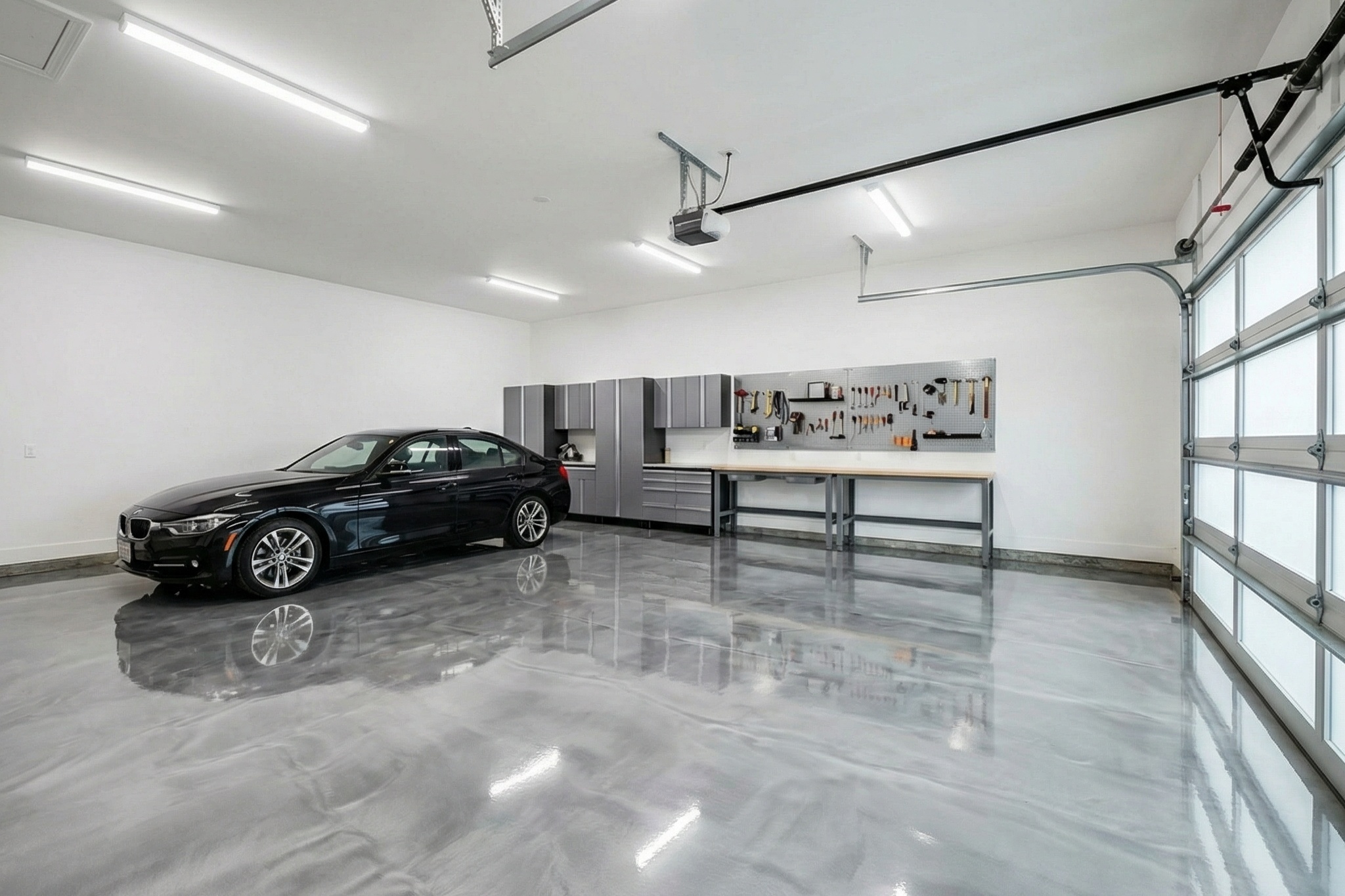
Metallic epoxy runs $8 to $12 per square foot installed on a typical two-car garage, and up to $15 for multi-color designs, detailed interiors and small rooms. Material costs only $1.50 to $2.00 per square foot more than flake. The rest of the gap is labor: the installer shapes the pattern by hand inside a short working window, and there are no chips to hide a mistake.
What goes into the material cost
Metallic Material Costs by Component
| Component | Cost/sq ft | Notes |
|---|---|---|
| Primer | $0.50–$1.00 | Moisture-mitigating primer costs more |
| Clear 100% solids carrier resin | $1.00–$2.00 | Doubles for two-coat designs |
| Metallic pigment | $0.75–$1.50 | $15–$30 per lb; color-shifting pigments cost the most |
| Polyaspartic topcoat | $1.00–$2.00 | UV stable; the right topcoat for any garage |
Pigment load sets both the look and the pigment bill: roughly 1 to 2 oz per 100 sq ft for a subtle shimmer, 4 to 6 oz per 100 sq ft for full metallic intensity. Plan on 10–15% material overage for metallic, against 5–10% for flake. Running short mid-pour leaves a seam you cannot hide, and mixed resin cannot be saved for the next job.
Where the labor goes
Prep runs $1.50 to $3.00 per square foot because metallic needs a cleaner, smoother base than flake. Application runs $2.50 to $4.50 per square foot. On a 450 sq ft garage, a two-person crew spends 1 to 2 hours broadcasting flake and 4 to 6 hours pouring and working metallic. Open time is short, typically 15 to 25 minutes depending on temperature, so the crew cannot stop to rework a section.
Day 1: Prep and prime
Diamond grind, repair cracks, clean up, test for moisture and prime. About 6 to 8 hours for a two-person crew on a standard garage.
Day 2: Metallic coat
Mix and pour the metallic resin and work the pigment flow. Four to six hours of active work, then an overnight cure.
Day 3: Topcoat
Knock down any high spots and roll the polyaspartic topcoat. Two to three hours of work. Walkable in 4 to 6 hours, drivable in 24 to 48.
Metallic Epoxy Installed Cost by Space (2026)
| Space | Typical Size | Cost/sq ft | Total Range |
|---|---|---|---|
| 1-car garage | 200–250 sq ft | $10–$15 | $2,000–$3,750 |
| 2-car garage | 400–500 sq ft | $8–$12 | $3,200–$6,000 |
| 3-car garage | 600–750 sq ft | $8–$11 | $4,800–$8,250 |
| Basement | 800–1,200 sq ft | $8–$12 | $6,400–$14,400 |
| Living area / interior | 300–700 sq ft | $10–$15 | $3,000–$10,500 |
| Commercial showroom | 1,500–3,000 sq ft | $9–$14 | $13,500–$42,000 |
| Commercial, 5,000+ sq ft | 5,000+ sq ft | $7–$11 | $35,000–$55,000+ |
Margin Insight
Two ways to give a customer a metallic option below full metallic pricing: a metallic accent zone of 50 to 100 sq ft inside a flake floor, priced at $12 to $18 per square foot for that area only, or single-color metallic as the base metallic price with multi-color blends quoted as a $1 to $3 per square foot upgrade.
Line Items That Move the Price
The gap between a low and a high quote on the same garage is usually under the coating. Price these line items after you walk the slab, so they show up in the quote instead of as change orders on install day.
Common Add-On Costs
| Item | Cost Range | When It Applies |
|---|---|---|
| Minor crack repair | $2–$5/linear ft | Hairline and non-structural cracks |
| Structural crack repair | $5–$15/linear ft | Wider or moving cracks |
| Spalling or delamination repair | $3–$8/sq ft | Surface flaking or crumbling |
| Old coating removal | $3–$8/sq ft | Paint, epoxy or sealer has to come off |
| Oil stain removal | $50–$200 | Depends on depth and spread |
| Moisture testing | $200–$500 | Plastic sheet or calcium chloride kit |
| Moisture-mitigating primer | $1–$2/sq ft | Only if the slab fails the test |
| Expansion joint treatment | $3–$6/linear ft | Flexible fill or cap strips |
| Garage door threshold seal | $100–$250 | Water coming in at the door |
| Complex layout | +10–20% labor | Columns, steps, jogs |
| Custom color or multi-color metallic | +$1–$3/sq ft | Anything outside stock blends |
On older slabs, tell the customer to expect 10–20% above the base coating price once repairs are counted, and show each repair as its own line. A repair the customer watched you point at during the walkthrough is far easier to accept than one that appears on install day.
What a Low Epoxy Quote Usually Leaves Out
At $3 per square foot there is no room for diamond grinding, quality material and a polyaspartic topcoat while still paying a crew. Run the numbers on a 500 sq ft garage at $1,500: about $750 in material at $1.50 per square foot, about $500 in labor, and $250 left for overhead and profit. Diamond grinding alone runs $1 to $2 per square foot. Something has to come out, and it is usually prep.
- 1Acid etching instead of diamond grinding. Etching does not remove old sealers or leave a consistent profile.
- 2Water-based or low-solids product. Retail-grade films go down at 3–5 mils against 12–20+ mils for a professional system.
- 3No moisture test, on a slab that may not have a vapor barrier.
- 4No topcoat, or an epoxy clear coat that yellows in sunlight and softens under hot tires.
- 5Crack repair left out of the price, then added as a change order on install day.
- 6A price given over the phone without anyone looking at the slab.
When a customer brings you a cheaper number, compare prep method, product, film build, topcoat and warranty line by line. DIY kits fall in the same bucket: $100 to $500 at a big-box store, a thin water-based film and an acid etch. Stripping a failed coating and redoing it properly typically runs $2,000 to $4,000 on a two-car garage, more than coating bare concrete because the old material has to come off first.
How to Quote and Present Options on the Customer's Floor
Customers compare price per square foot, but they decide on what they can see. A chip sample shows the finish up close. It does not show 450 square feet of it next to their cabinets, under their lights. The workflow below keeps the price and the picture together from the first visit to the follow-up.
Walk the slab with the customer
Measure, point out cracks, oil stains, old sealers and slope, and run a quick moisture check while they watch. Every condition you point out becomes a line item they already understand.
Photograph the space
Shoot from the doorway or a corner with the lights on and the floor filling most of the frame. The same photo carries every option you show.
Show two or three options on that photo
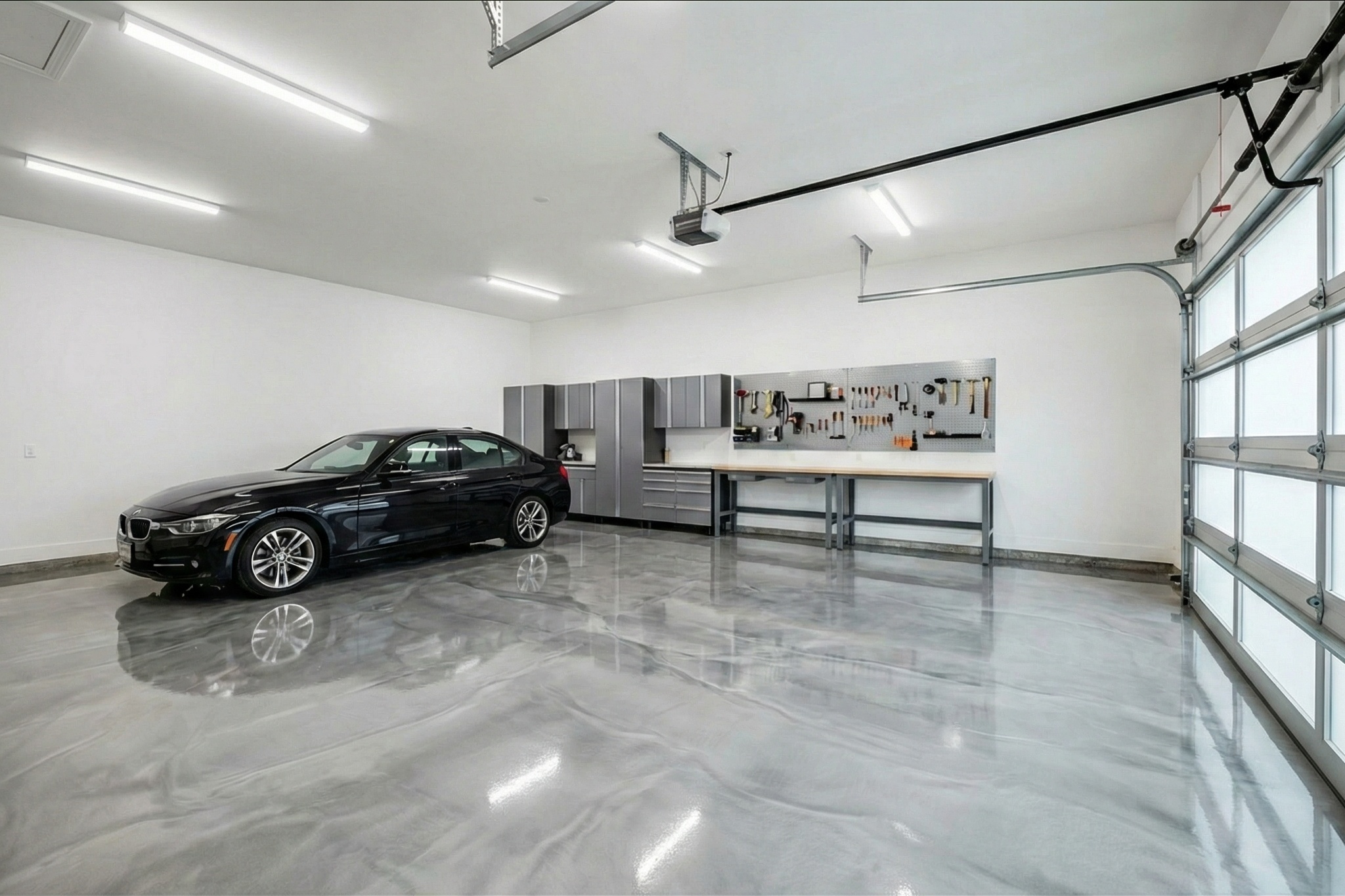
Put the core system and one step up on the customer's own floor, for example a full-broadcast flake and a metallic. ShowFloor is built for this step: upload the photo, pick the system and color, and the finish is shown on their slab. Confirm the final color with a physical sample.
Attach a price to each option
Price every option from the same measurements and the same prep and repair lines, so the only difference between them is the system. Give a per-square-foot rate the customer can hold up against other quotes.
Send the proposal the same day
Include the previews, the itemized scope (prep method, products, number of coats, topcoat), the repair lines, the schedule and the day they can drive on the floor.
Follow up on a set date
Agree on the day before you leave. If the answer is "let me think about it," ask which part they are unsure about: price, timing, or someone at home who has not seen the options yet. Send that person the previews.
Example Options on a 450 sq ft Two-Car Garage
| Entry | Core | Premium | |
|---|---|---|---|
| System | Solid color epoxy | Full-broadcast flake | Metallic epoxy |
| Prep | Diamond grind | Diamond grind + crack repair | Diamond grind + crack repair + skim coat |
| Topcoat | Polyurethane | Polyaspartic | Polyaspartic (2 coats) |
| Price/sq ft | $4–$5 | $6–$7 | $10–$12 |
| Price | $1,800–$2,250 | $2,700–$3,150 | $4,500–$5,400 |
| Target gross margin | 30–35% | 40–50% | 50–60% |

Handling the price conversation
- "Your price is too high": break the total into grinding, repairs, moisture testing, product, topcoat and warranty so every dollar has a job.
- "Someone quoted less": ask what prep method, product and topcoat the other quote specifies. Compare systems, not totals, and never knock the other contractor by name.
- "I can do it myself": ask whether they own a grinder, know their slab moisture and have rolled a fast-cure topcoat. The questions make the work visible without an argument.
Pro Tip
Quote the core option first, then show the metallic on the same photo without pitching it. If the customer asks what it costs, give the difference as an add-on to the core price rather than a brand-new total.
What Every Epoxy Quote Should Spell Out
- An in-person look at the slab before any price
- Itemized prep, materials, labor and topcoat
- Product names and manufacturer
- Prep method stated: diamond grinding or shot blasting
- Crack repair and patching as their own line items
- Moisture testing included
- Topcoat type: polyaspartic or polyurethane
- Warranty terms that cover labor as well as material
- Schedule, including when the floor takes foot traffic and vehicles
A quote that spells these out is easier to defend against a lower number, because the customer can see exactly what the lower number skipped.
Featured Materials
$3–$5/sq ft
Solid Gray
Entry-level protection. A clean, uniform look for budget-conscious customers and utility spaces.
$4–$7/sq ft
Domino Flake
Full-broadcast flake that hides small imperfections and adds grip. The core garage option.
$6–$10/sq ft
Saddle Tan Quartz
Textured quartz with strong chemical and impact resistance for workshops and heavy-use garages.
$8–$12/sq ft
Silver Metallic
Flowing, one-of-a-kind patterns. The premium option on most garage quotes.
Put a Price on Every Option They Can See
Try it on a photo of a current job: show solid, flake or metallic on the customer's own floor, price each option, and send the proposal from the same place.