Floor Coating Systems Compared: Choosing by Space and Upkeep
Epoxy, polyaspartic, polished concrete, stain, paint and tiles side by side, with the slab checks, cure times and maintenance that decide which one to quote.
Every Floor System at a Glance
Every option for a concrete floor does one of three things. It coats the slab (epoxy, polyaspartic, polyurea, paint), it turns the slab itself into the finish (polished concrete), or it colors the slab and relies on a sealer (acid stain, water-based stain, dye). Tiles sit on top and do none of these. Which approach fits depends first on the slab and the use, and only then on the look.
Floor Systems Compared (2026)
| System | Installed Cost/sq ft | Typical Lifespan | Return to Service | Best Fit |
|---|---|---|---|---|
| Epoxy: solid, flake, quartz | $3–$10 | 5–20 yrs by system | Vehicles in 72 hrs to 5 days | Garages, basements, workshops |
| Metallic epoxy | $8–$12 (to $15) | 15–20 yrs | Same as epoxy | Showroom garages, basements, retail |
| Polyaspartic (full or topcoat) | $5–$12 | 15–20+ yrs | Foot traffic in 4–6 hrs | Fast turnaround, sun-exposed floors |
| Polyurea (spray-applied) | $7–$15 | 15–20+ yrs | Foot traffic in 1–4 hrs | Commercial, chemical exposure |
| Polished concrete | $3–$12 | 20+ yrs | Immediate | Sound slabs, commercial, retail |
| Concrete stain + sealer | $2–$10 | Acid stain color 20+ yrs; sealer 1–5 yrs | 2–3 days to install | Patios, dry basements, restaurants |
| Urethane mortar | $8–$12 | 15+ yrs | Product dependent | Commercial kitchens, food processing |
| Garage floor paint | $1–$3 | 1–3 yrs | 24–48 hrs | Rentals, short-term fixes |
| Interlocking tiles | $3.50–$8 | 10–15 yrs | Immediate | No prep, removable, show cars |
Prices are for professional installation with proper prep. Polished concrete runs from the low end of its range for a honed finish to the high end for a 3,000-grit mirror polish. For the epoxy systems broken down by material, labor and garage size, see our epoxy flooring cost guide.
Start With the Slab, Then the Use
Check the slab
Look for cracks, spalling, old coatings, adhesive residue and oil. A sound, clean slab keeps every option open. A damaged or contaminated slab points to a coating, because polishing and stain show every flaw and stain cannot react through oil or old sealers.
Test for moisture
Tape a 2 x 2 ft plastic sheet to the slab for 24 to 48 hours, or run a calcium chloride test (ASTM F1869). Many epoxy products are rated to around 3 lbs per 1,000 sq ft per 24 hours; the product data sheet sets the limit. Above it, a coating needs a moisture-mitigating primer, and an acrylic sealer over stain will haze or peel.
Name the use
Vehicles, workshop chemicals, food washdowns, forklifts, foot traffic only, or full sun. The use rules out more systems than the budget does.
Ask about downtime
A customer who needs the floor back the next day is a polyaspartic or tile customer. Three to five days opens up standard epoxy. Occupied commercial sites usually need overnight or weekend phases.
Show the short list on their floor
Two or three systems that pass the first four checks, each priced, on a photo of the customer's own space.
Garages: Coat the Slab
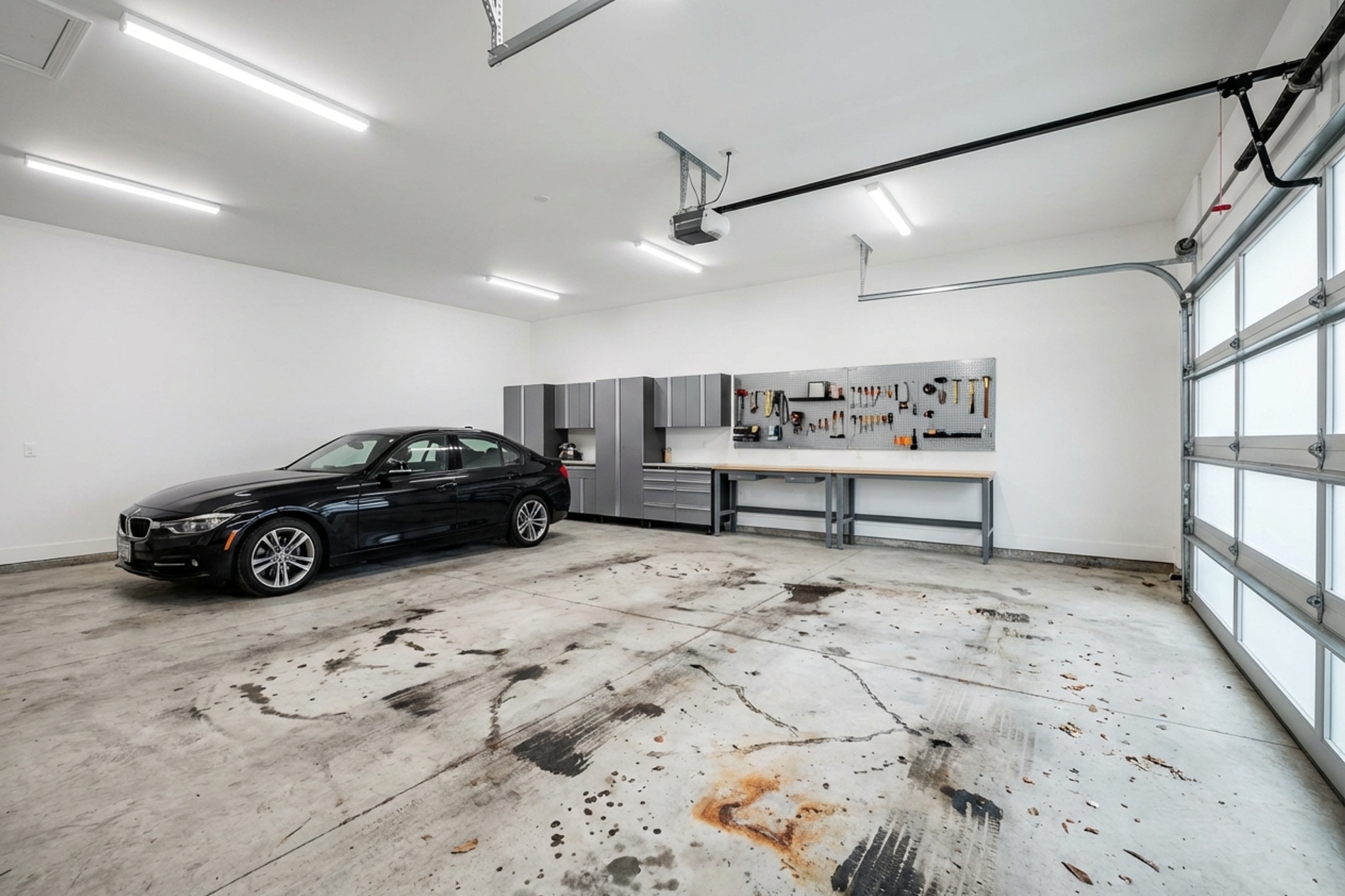
A garage that holds vehicles needs a coating. Oil, brake fluid, antifreeze, road salt and hot tires rule out the alternatives. Polished concrete has no sacrificial layer, so fluids stain it and salt erodes the surface. Stain under an acrylic sealer looks good until hot tires soften the sealer and pull it up. Paint sits on the surface without bonding and typically needs redoing every 1 to 3 years.
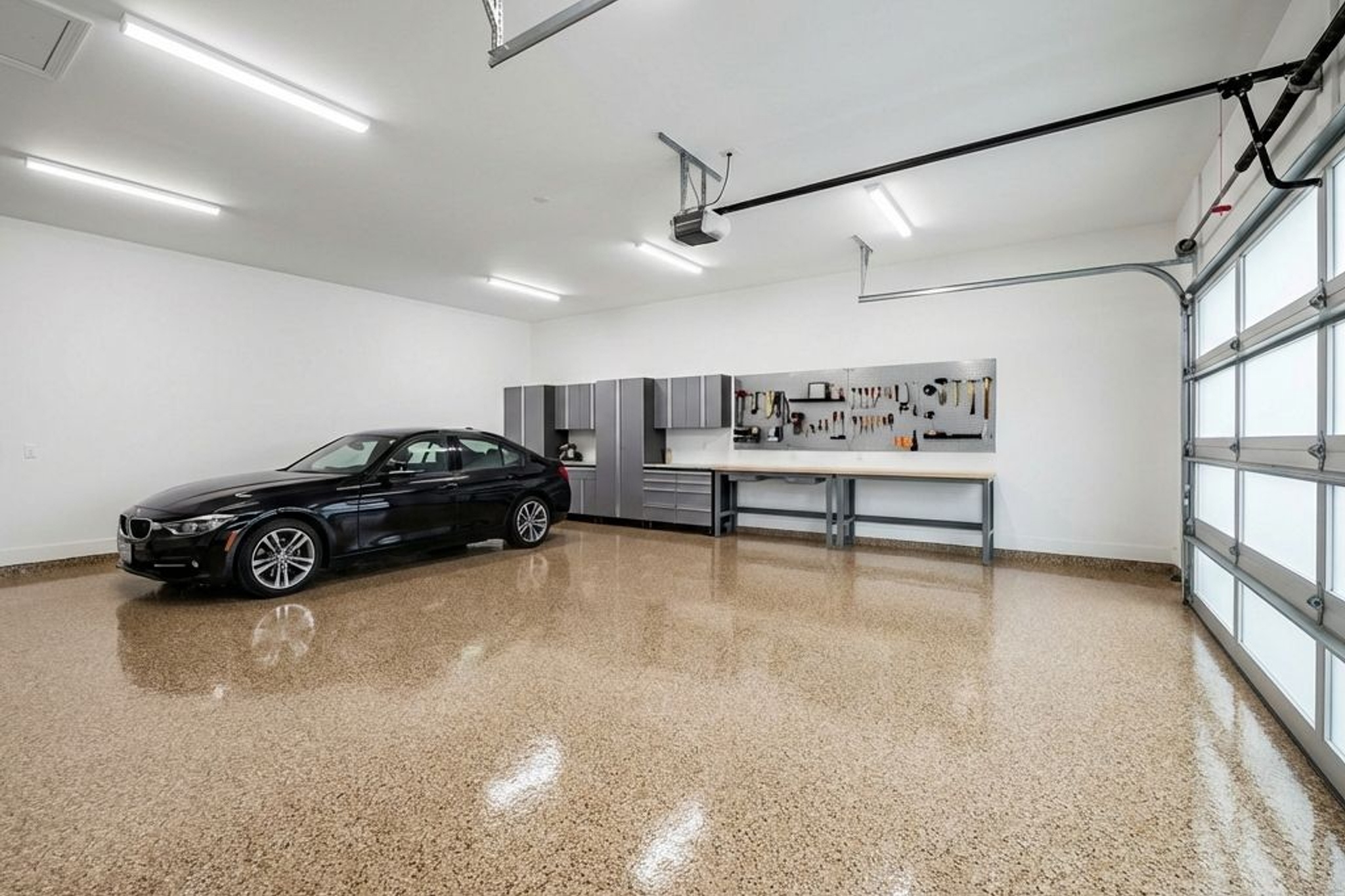
The standard garage quote is a 100% solids epoxy base, flake or quartz broadcast, and a polyaspartic topcoat that stays clear in sunlight and resists hot tire pickup. Full polyaspartic suits customers who need the garage back the next day. Spray polyurea is mainly a commercial product, and our polyurea vs epoxy guide covers that comparison in detail. Tiles fit renters, show-car owners who want patterns, and slabs too damaged to coat without major repair.
Polished Concrete vs Epoxy
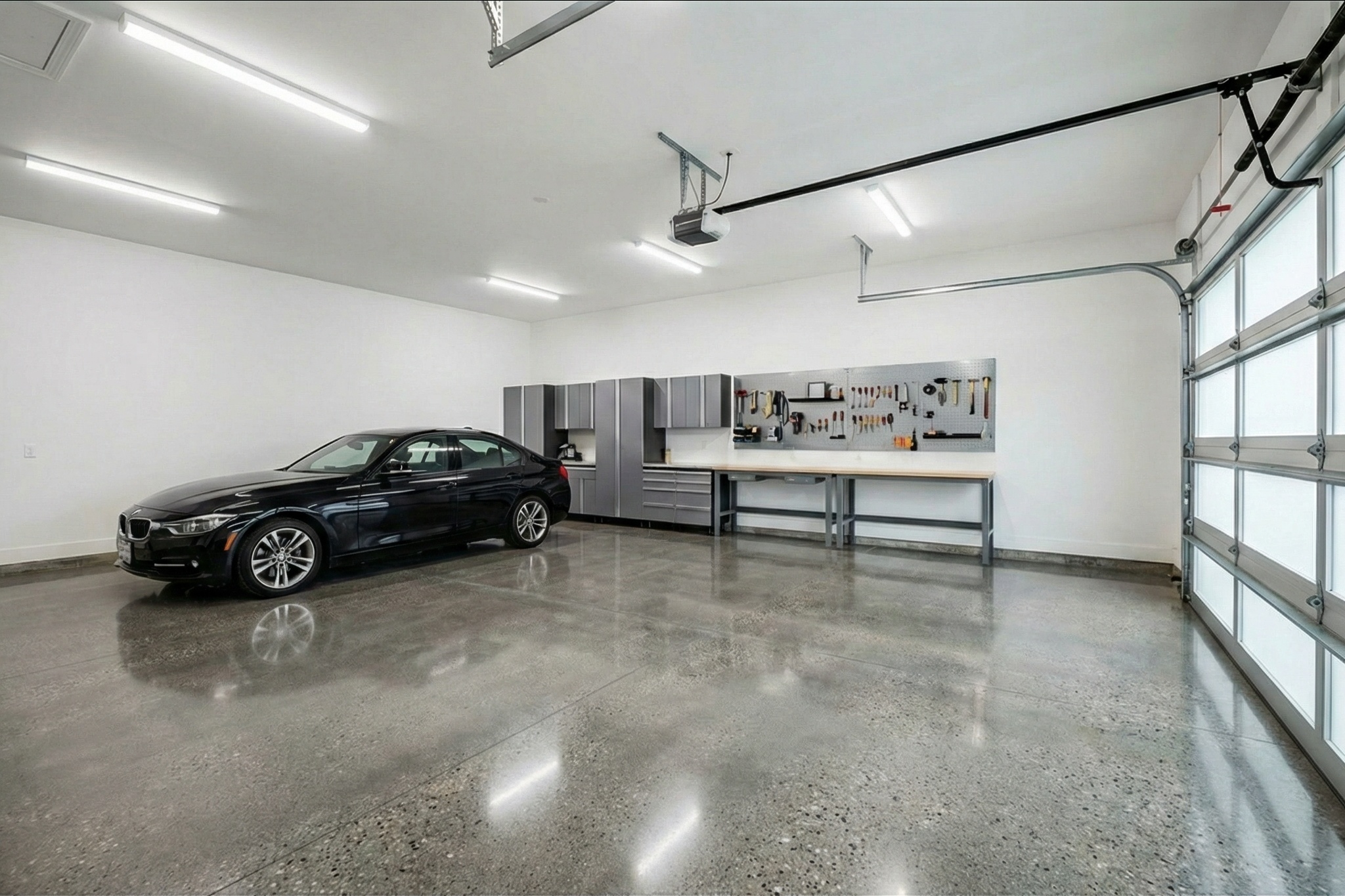
Both run roughly $3 to $12 per square foot installed, but they answer different questions. Polishing grinds the existing slab with progressively finer diamonds until the concrete itself is the finish. Epoxy builds a new surface on top. Polishing needs a sound slab and rewards it. Epoxy covers a slab that has seen hard use.
Coarse grind (30–50 grit metal bond)
Removes coatings, adhesives and surface defects and flattens the slab.
Medium grind (100–200 grit metal bond)
Refines the scratch pattern. Crack and joint repair happens at this stage.
Densifier
Lithium or sodium silicate hardens the surface. Applied after 200 grit, before the resin-bond passes.
Hone (400 grit resin bond)
A low sheen. A good stopping point where slip resistance matters more than gloss.
Polish (800–1,500 grit resin bond)
800 grit gives a satin finish; 1,500 a semi-gloss that reflects overhead lights.
High polish (3,000 grit resin bond)
Mirror-like. Common in retail, showrooms and lobbies.
Polished Concrete vs Epoxy
| Factor | Polished Concrete | Epoxy Coating |
|---|---|---|
| Slab requirement | Sound and clean, no major cracks or patches | Can cover cracks, patches and stains |
| Chemical resistance | Low; oils and acids stain it | High with the right topcoat |
| Look | Natural gray tones and exposed aggregate | Any color, flake, quartz or metallic |
| Sunlight | No coating to yellow | Needs a polyaspartic or polyurethane topcoat |
| Slip resistance | Can be slick when wet at high gloss | Aggregate can be broadcast for grip |
| Long-term upkeep | Dust mop, burnish, re-polish | Dust mop, damp mop, recoat the topcoat |
| Contractor equipment | $40,000–$100,000 to set up | Far lower entry cost |
The two also combine. Honing to 400–800 grit, densifying and finishing with a thin clear epoxy or polyurethane gives the polished look with stain protection, at about $6 to $10 per square foot. Large commercial sites often split by zone: polished concrete in customer areas, epoxy in service bays and kitchens.
Concrete Stain and Dye: Color Without a Coating
Stain is not paint and not a coating. It penetrates the concrete and colors it, so the floor keeps the look and feel of concrete. It does not protect the slab. The sealer on top does that, and the sealer is what the customer maintains.
Stain and Dye Options
| Product | How It Works | Colors | Installed Cost/sq ft | Watch For |
|---|---|---|---|---|
| Acid stain | Metallic salts react with the concrete to form permanent color | Earth tones and blue-greens only | $2–$4 basic; $5–$10 decorative | Hazardous acid; color varies slab to slab |
| Water-based stain | Acrylic carrier deposits pigment in the pores | Nearly any color | $3–$6 | Relies on the sealer; looks painted if applied heavy |
| Concrete dye | Fine pigment in acetone or water, no reaction | Wide range | $2–$5 | Not UV stable; interior only |
Stain works on patios and outdoor slabs (acid stain under a breathable, UV-stable acrylic sealer), dry basements, restaurants and shops where a scored two-color pattern stands in for tile, and faded decorative concrete that needs a color refresh. Dye is the standard colorant for polished concrete, applied partway through the grit sequence so later passes lock it in.
Stain fails in garages with vehicles, on high-traffic commercial floors where the sealer wears into visible lanes, in basements with moisture pushing up through the slab, and on slabs with oil or old coatings that block the reaction. A slab that needs a cementitious overlay before staining moves to $8 to $15 per square foot, because you are building a new surface first.
Warning
Do a test patch on the actual slab before you price a stain job, especially on older concrete, and let the customer approve the color. Acid stain needs full protection: chemical-resistant gloves, splash goggles, a respirator with acid gas cartridges and good ventilation.
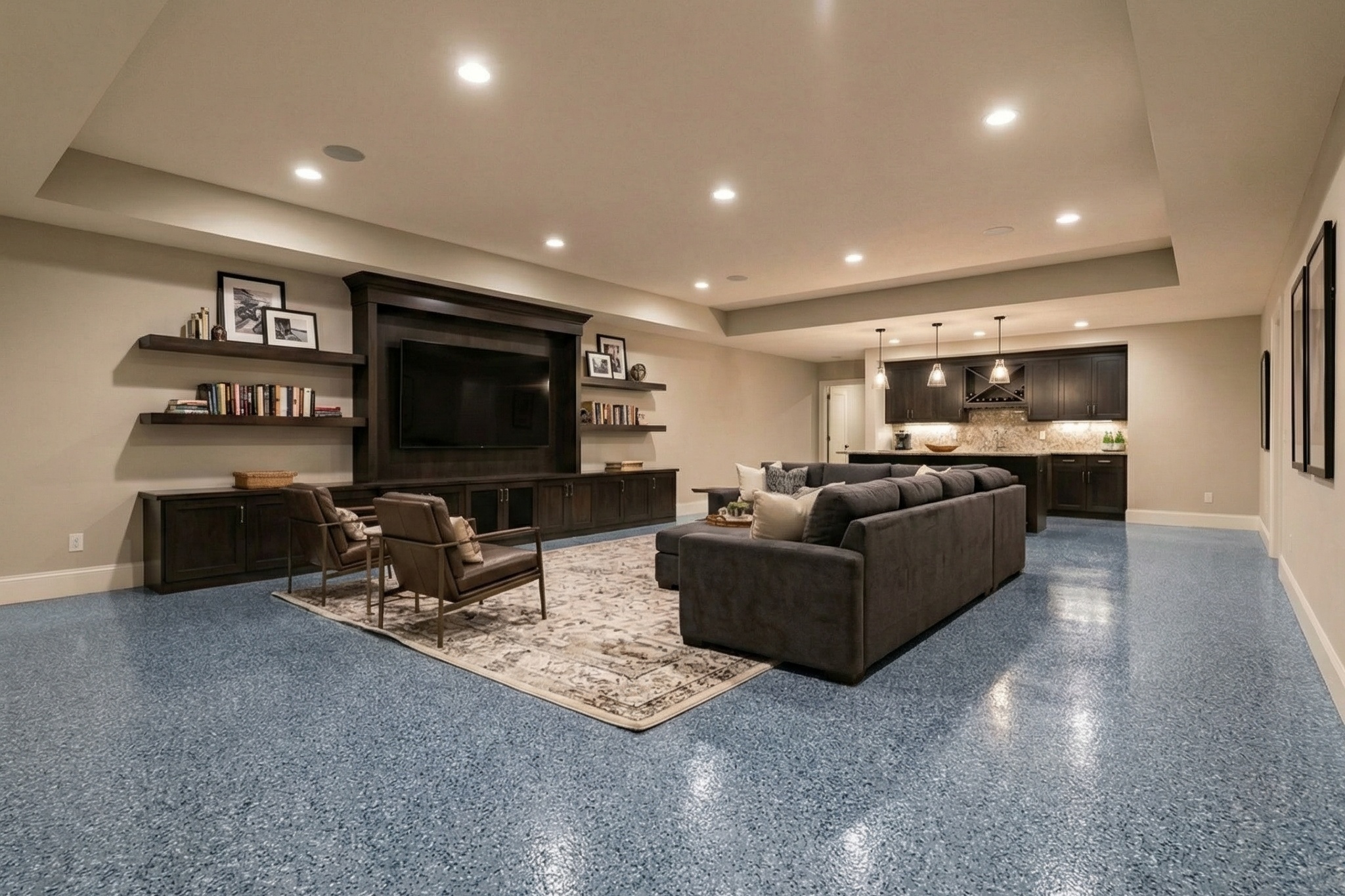
Basements: Moisture Decides
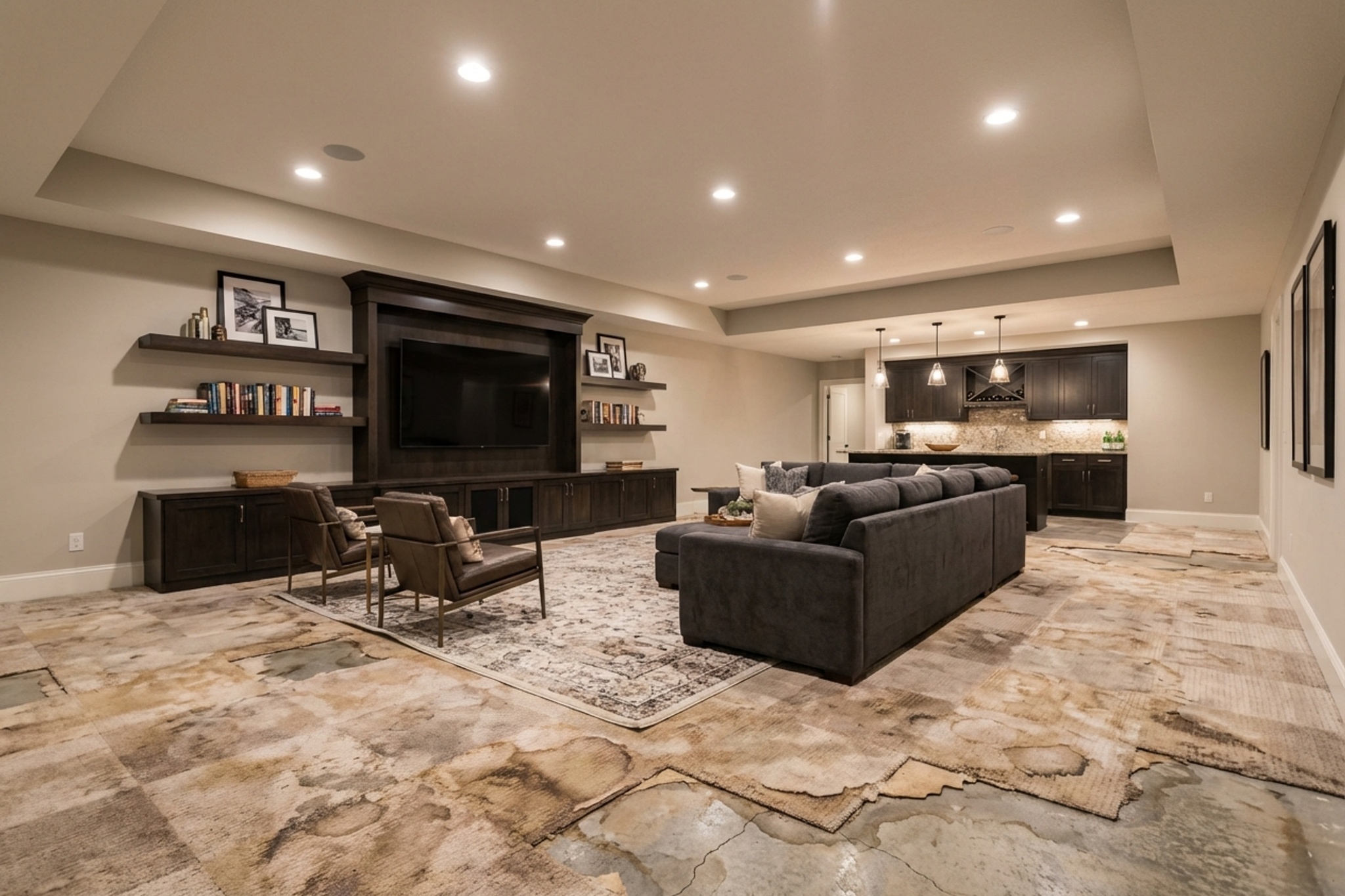
Below-grade slabs are the most likely to carry moisture, so test every basement before you quote it. A dry slab can take any coating, or stain if the customer wants the concrete look. A wet slab needs a moisture-mitigating primer under a coating, which adds $1 to $2 per square foot and usually a day to the schedule. At that point stain stops being the budget option.
Flake hides wear from furniture and foot traffic, solid color reads clean, and metallic turns a utility basement into a finished room. Tell the customer to run a dehumidifier if the space stays above 60% relative humidity and to put felt pads on furniture legs. Our basement flooring ideas guide covers more options for below-grade rooms.
Commercial Floors: Match the System to the Spec
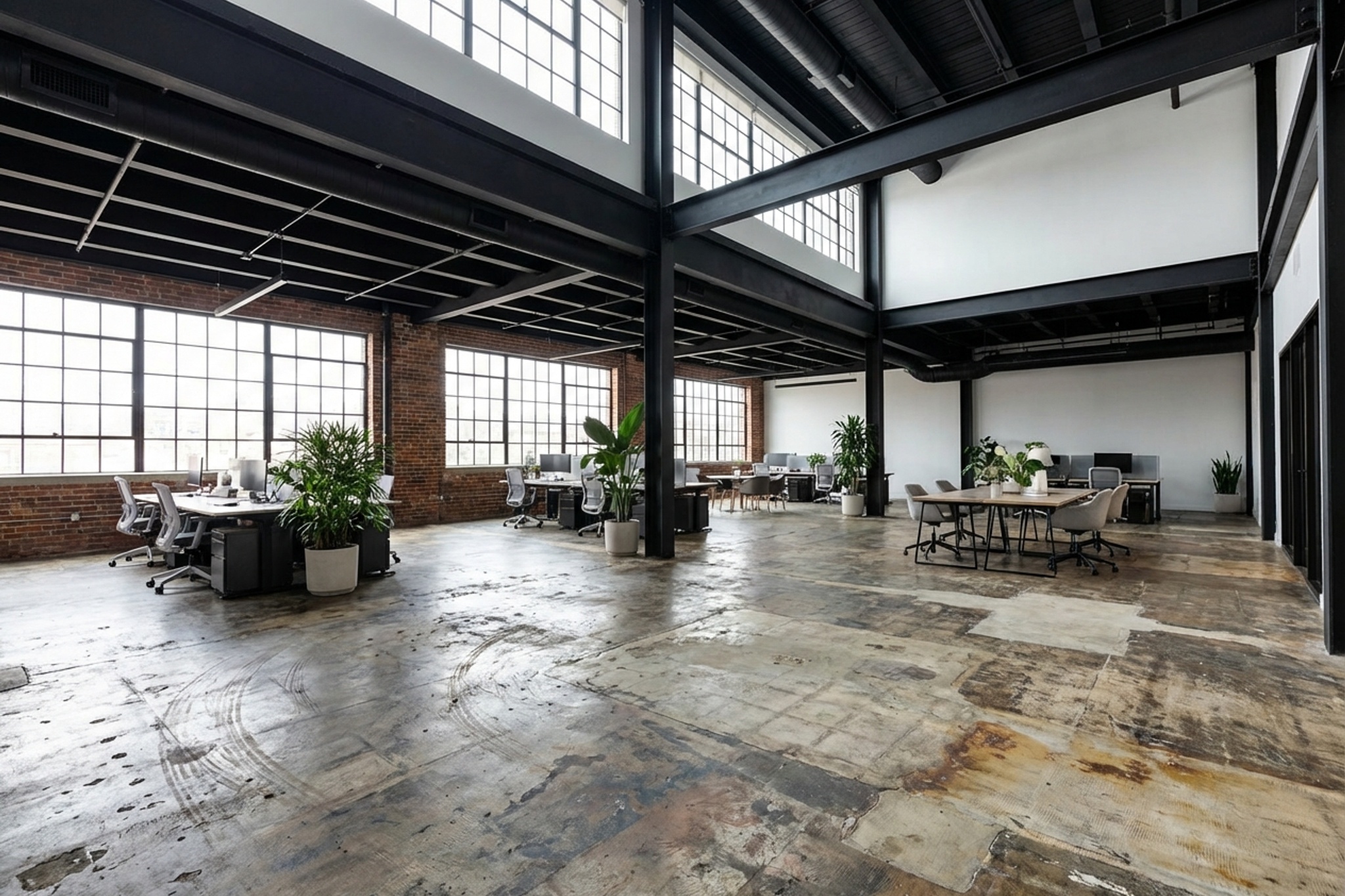
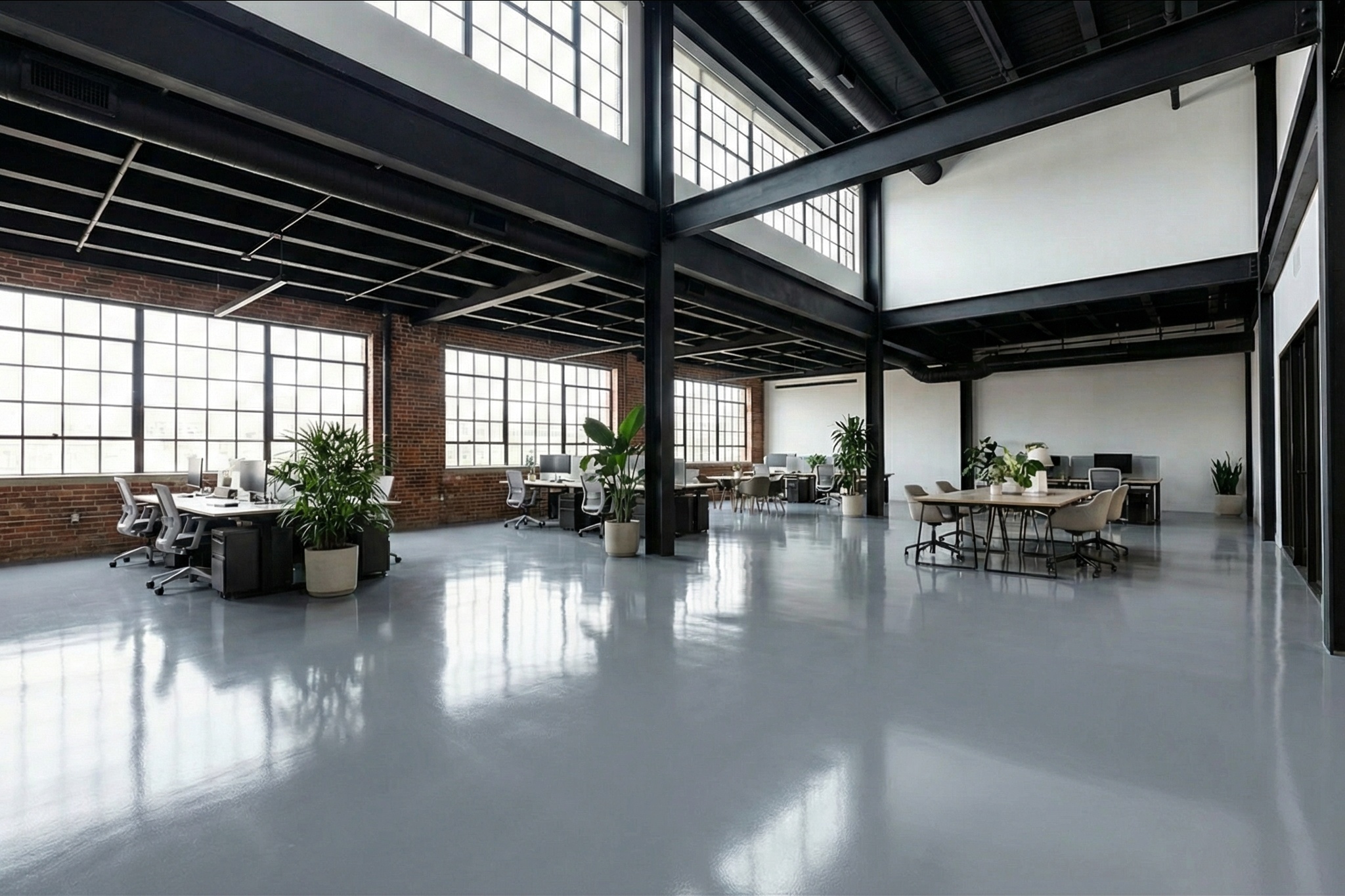
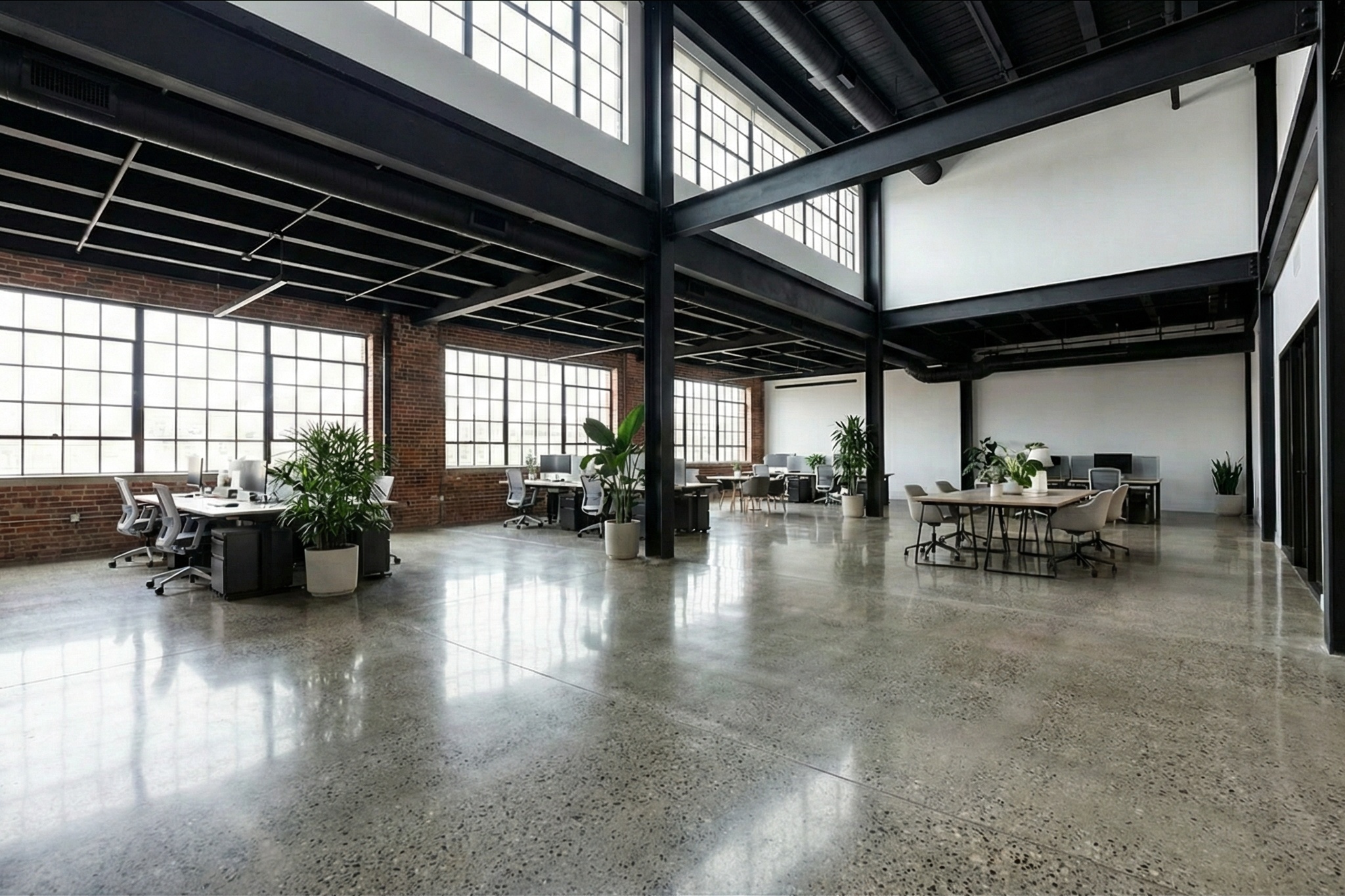
Commercial work starts from a written spec and an operating schedule. The system is chosen by what the floor has to survive: washdowns, forklifts, disinfectants, static, or showroom lighting.
Commercial Systems by Use
| Use | Typical System | Installed Cost/sq ft | Why |
|---|---|---|---|
| Warehouse, distribution | High-build epoxy + polyurethane topcoat | $3–$5 | Abrasion and impact resistance at a low per-foot price |
| Commercial kitchen, food processing | Urethane mortar + integral cove base | $8–$12 | Handles hot-water washdowns and sanitation chemicals |
| Healthcare | Antimicrobial epoxy + polyurethane topcoat | $7–$12 | Seamless and resistant to disinfectants |
| Retail, showroom | Quartz broadcast, metallic or polished | $5–$8; metallic $9–$14 | Holds up to foot traffic and looks right under display lighting |
| Automotive service | Chemical-resistant epoxy | $4–$7 | Fuel, oil and brake fluid |
| Chemical storage, battery rooms, labs | Novolac epoxy | $7–$12 | Resists acids and solvents standard epoxy cannot |
| Electronics, server rooms | ESD (static-dissipative) epoxy | $8–$15 | Grounded floor tested to ANSI/ESD S20.20 |
Food facilities need a seamless, non-absorbent floor with a cove base at the walls and resistance to the sanitation chemicals in use. Before you bid, ask the coating manufacturer for the documentation that facility type requires; it is not the same for a restaurant kitchen as for a processing plant.
Downtime and phasing
Most occupied sites are coated in zones over nights or weekends. Polyaspartic takes foot traffic in 4 to 6 hours, which makes overnight work possible. Standard epoxy needs 24 to 48 hours before foot traffic. Build the schedule backward from the cure time, and price night work at a premium.
Prep and moisture at scale
Shot blasting covers open floor quickly, typically 3,000 to 6,000 sq ft per hour against 500 to 1,000 for a walk-behind grinder, but it cannot reach edges and columns, so most jobs use both. Moisture varies across a large slab and runs wetter near exterior walls and loading docks, so test in many locations. In-situ relative humidity probes (ASTM F2170) are the usual commercial method, and the coating manufacturer sets the acceptable reading. A moisture vapor barrier system adds $1.50 to $3.00 per square foot.
Good to Know
Property managers think in total cost of ownership. For each option, lay out the install price, yearly maintenance and the recoat or re-polish schedule over ten years rather than the install price alone.
Cure and Return-to-Service Times
Return to Service by System
| System | Foot Traffic | Vehicles / Heavy Use |
|---|---|---|
| Standard epoxy | 24–48 hours | 72 hours or more; full cure 5–7 days |
| Fast-cure epoxy | 8–12 hours | About 24 hours |
| Polyurethane topcoat | 12–24 hours | 48–72 hours |
| Polyaspartic | 4–6 hours | 8–48 hours, by product |
| Spray polyurea | 1–4 hours | 4–8 hours |
| Polished concrete | Immediate | Immediate |
| Acid stain + sealer | After reaction, rinse, 24-hour dry and sealer | Sealer dependent |
| Garage floor paint | 24–48 hours | Per the product label |
| Interlocking tiles | Immediate | Immediate |
Give the customer the schedule in writing. A coating can feel hard to the touch well before full cure, and driving on it early can leave permanent tire impressions.
Upkeep by System
Maintenance by System
| System | Routine Care | Periodic Work | Typical Interval |
|---|---|---|---|
| Epoxy / polyaspartic, residential garage | Sweep 2–3 times a week; damp mop weekly with a pH-neutral cleaner | Topcoat recoat | 5–7 years |
| Epoxy, commercial or industrial | Sweep daily; scrub or auto-scrub weekly | Topcoat recoat; traffic lanes sooner | 3–5 years |
| Epoxy, basement | Sweep and mop every two weeks | Topcoat recoat | 7–10 years |
| Polished concrete | Dust mop; damp mop with a neutral cleaner | Burnish; re-polish in commercial use | 5–10 years to re-polish |
| Stained concrete | Dust mop; neutral cleaner | Reseal | Interior 3–5 yrs; exterior 2–3; commercial 1–2 |
| Garage floor paint | Sweep and mop | Repaint | 1–3 years |
Recoat or start over
Recoat vs Full Strip and Redo
| Recoat | Strip and Redo | |
|---|---|---|
| Cost per sq ft | $2–$4 | $7–$18 |
| Two-car garage (450 sq ft) | $900–$1,800 | $3,150–$8,100 |
| Downtime | 1–2 days | 3–5 days |
| Process | Scuff, clean, new topcoat | Grind off, re-prep, full system |
| When it applies | Base coat still bonded | Peeling, delamination or moisture |
The signs a topcoat is wearing: gloss gone in traffic lanes and tire tracks, scratches that no longer clean out, base color or chips showing through, water that sheets instead of beading, and stains that set faster than they used to. Catch these early and the job stays a recoat.
Care rules for the customer's maintenance sheet
- Use a pH-neutral cleaner. No vinegar, citrus cleaners, Pine-Sol or undiluted bleach.
- Use a soft-bristle broom or microfiber mop. No wire brushes, melamine sponges or steel wool.
- Sweep road salt off the same day. Salt holds moisture against the floor.
- Clean up solvents, gasoline, brake fluid and battery acid right away. Oil and antifreeze mostly stain light colors rather than damage the coating.
- Keep a pressure washer under about 1,200 PSI with a wide fan tip, or use a hose and mop.
- Lift heavy equipment instead of dragging it, and use rubber mats under battery chargers and chemical storage.
- Skip automotive wax. The topcoat is already sealed.
Pro Tip
Keep a labeled jar of the original color and matching flake from every job. When the customer calls about a chip years later, the repair blends in instead of turning into a color-matching project.
Walking the Customer Through the Choice
Most customers arrive with a look in mind, not a system. The job at the estimate is to turn that look into a system that suits their slab and their use, and to show them the difference between the two or three that would work.
Photograph the space at the walkthrough
After you check the slab and run the moisture test, take one photo from the doorway with the lights on and the floor filling most of the frame.
Show the short list on that photo
For a garage, a flake system and a metallic or polished alternative. For a dry basement, a coating and a stain. For a commercial client, a coating and polished concrete. ShowFloor applies each system to the customer's own photo, so they compare floors in their own room rather than in a brochure.
Price each option with its upkeep
Put the install price, the return-to-service time and the maintenance interval next to each preview. A stained floor that needs resealing every few years and an epoxy floor that needs a recoat at year five to seven are different purchases.
Send the proposal with the care sheet
Include the previews, the itemized scope and the maintenance rules for the system they choose.
Follow up on a date you set together
If someone in the decision was not at the walkthrough, send them the previews and the priced options.
Featured Materials
Epoxy Broadcast
Domino Flake Epoxy
Black and gray chips on a charcoal base. The standard choice for residential garages.
Polished Concrete
Titanium Polish
Mechanically polished slab with densifier. Industrial and minimal, with no coating to wear.
Stained Concrete
Cola Acid Stain
Deep brown-black with natural mottling. A common acid stain color for basements and restaurants.
Solid Epoxy
Cool Gray Solid
Clean, uniform gray for warehouses and shops where performance comes first.
Urethane Mortar
Terracotta Urethane Mortar
Cementitious urethane for commercial kitchens and food processing. Built for hot-water washdowns.
Show Each System on Their Own Floor
Try it on a photo of a current job: compare a coating, polished concrete or stain on the customer's actual space, price each option, and send one proposal.
Frequently Asked Questions
Related Guides
Pricing Guide
Epoxy Flooring Cost per Square Foot in 2026
Garage Flooring Guide
The Best Epoxy Flooring for Garages in 2026
Coating Comparison Guide
Polyurea vs Epoxy Flooring: What Contractors Actually Need to Know
Patio Coatings Guide
Patio Floor Coatings: What Actually Lasts Outdoors
Basement Flooring
Best Basement Flooring Options for Every Budget